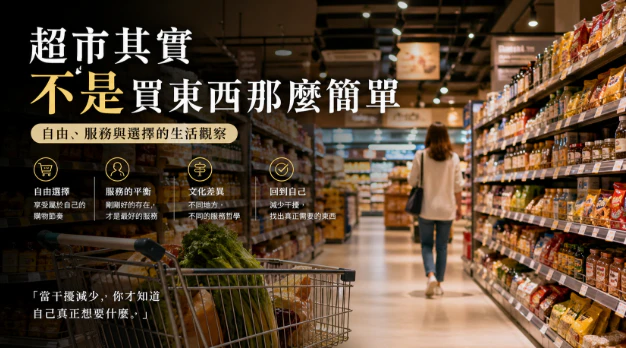
每天走進超市,我們以為只是買東西,其實是在做一連串關於選擇、節奏與感受的決定。從是否被打擾,到如何被引導,每一個細節,都影響我們對生活的理解。
A trip to the supermarket may seem routine, but it quietly shapes how we experience choice, pace, and control. From subtle influences to personal decisions, every detail reflects how we relate to everyday life and how much freedom we truly have.
中文
當你走進超市,你以為自己只是來買東西,但其實你正在進入一個被設計過的空間,一個關於選擇、節奏與感受的場域。你推著購物車,慢慢走過貨架,看似隨意,其實每一個停留、每一次拿起與放下,都是一種微小但真實的決定。超市從來不只是供應生活所需的地方,它同時也是一個影響人如何思考與選擇的空間。有些人喜歡慢慢逛,在貨架之間尋找,像是一種日常的放鬆,有些人則只想快速完成購物,拿到需要的東西就離開,而這兩種節奏,往往會被同一個空間同時容納,但不一定被同樣尊重。當你正在比較兩種產品的時候,如果突然出現推銷或干擾,你的思考會被打斷,原本屬於你的節奏被改變,而這種感覺,正正是很多人對超市產生壓力的原因之一。超市的設計從來不只是擺放商品,動線、燈光、音樂、標籤甚至優惠位置,都在無聲地影響你的選擇,有時候你以為自己是因為需要而購買,其實只是因為被吸引或被引導,而當這種引導過多,就會變成一種壓力。很多人會發現,自己每次走進超市都會買多了,並不是因為真正需要,而是因為在這個環境之中,選擇變得不再單純。服務在這個空間中也變得微妙,當服務過多,會令人覺得被打擾,當服務過少,又會被認為不夠專業,而真正令人感到舒服的服務,往往不是主動出現,而是在需要的時候剛好存在。這種「存在但不打擾」的狀態,其實是一種很難拿捏的平衡。不同地方的超市,也反映出不同文化對服務的理解,有些地方重視效率,希望快速完成,有些地方強調禮貌與細節,有些地方則更在意個人空間與自由,而這些差異,並不是好壞,而是對「人應該被怎樣對待」的不同答案。當我們開始留意這些細節,就會發現,原來超市不只是生活的一部分,而是生活方式的一種反映。更重要的是,在這個充滿選擇的空間裡,真正重要的從來不是商品,而是你是否還保有選擇的主導權。當干擾減少,你才會發現自己真正需要的是什麼,而不是被告訴應該要什麼。也許最理想的超市,不是提供最多選擇,也不是最便宜,而是讓人可以在不被打擾的情況下,慢慢找到屬於自己的答案。
English Version
Walking into a supermarket often feels like a simple, routine task, yet the experience is far more complex than it appears. It is not just a place where goods are exchanged for money, but an environment carefully shaped to influence how people move, think, and decide. Every aisle, every product placement, and every visual cue plays a role in guiding behavior, often without conscious awareness. As you navigate through shelves, pausing occasionally to compare items or reconsider a choice, you are engaging in a continuous process of decision-making that reflects not only your needs but also your habits and preferences. Some people approach supermarkets slowly, treating them almost like a space for exploration, while others move with urgency, aiming to complete their shopping as efficiently as possible. These different rhythms coexist within the same environment, yet they are not always equally supported. When interruptions occur, such as unsolicited recommendations or overly aggressive promotions, the natural flow of thought is disrupted, turning what should be a personal process into a pressured experience. This subtle shift is often what creates discomfort, even if it is not immediately recognized. The design of a supermarket extends beyond its physical layout; lighting, sound, signage, and promotional displays all contribute to shaping perception and influencing decisions. What seems like a spontaneous purchase may, in reality, be the result of careful positioning and psychological triggers. This is why many people find themselves buying more than they originally intended, not because their needs changed, but because their environment guided them in a certain direction. Service, in this context, becomes a delicate balance. Too much interaction can feel intrusive, while too little may be perceived as neglect. The most effective form of service is often the one that remains almost invisible, present only when needed and absent when not. Different cultures approach this balance in distinct ways, reflecting broader attitudes toward personal space, efficiency, and social interaction. In some places, speed and practicality are prioritized, while in others, attentiveness and politeness take center stage, and elsewhere, the emphasis lies on respecting individual autonomy. These variations are not about which system is better, but about how each society defines a positive experience. When viewed through this lens, the supermarket becomes more than a functional space; it becomes a reflection of how people relate to choice and control in their daily lives. Ultimately, the most important element is not the abundance of products or the competitiveness of prices, but whether individuals retain the ability to make decisions on their own terms. When external noise is reduced, clarity emerges, and choices become more intentional rather than reactive. Perhaps the ideal supermarket is not the one that offers the most, but the one that allows people to quietly discover what they truly want without interference.
No Responses