
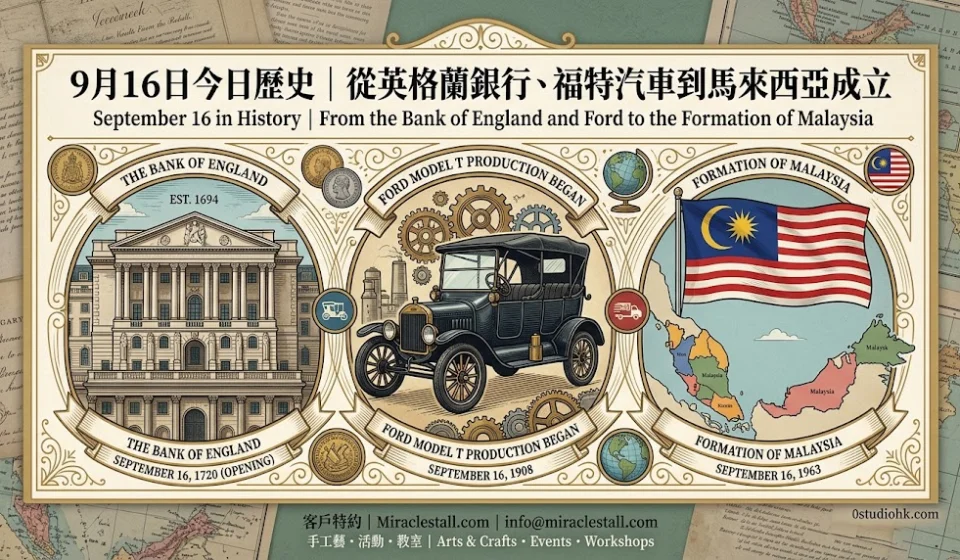
9月16日今日歷史|從英格蘭銀行、福特汽車到馬來西亞成立|September 16 in History|From the Bank of England and Ford to the Formation of Malaysia
9月16日記錄金融、工業、城市生活與國家發展,見證現代世界如何一步步形成。
September 16 connects finance, industry, urban life and nation-building in the development of the modern world.
中文版本
9月16日是一個很適合從「現代生活如何形成」角度閱讀的歷史日子。這一天沒有必要只聚焦於重大衝突,因為它同時見證金融制度、工業生產、城市交通、國家發展以及文化生活等不同方面的變化。1694年9月16日,英格蘭銀行正式成立。當時英國政府面對龐大的財政需要,需要建立更加穩定的融資方式,因此由威廉・帕特森等人推動成立銀行,並向政府提供大額貸款。英格蘭銀行後來逐漸成為英國金融制度的重要核心,亦在貨幣政策、銀行體系及金融穩定方面扮演重要角色。對普通人而言,中央銀行似乎是一個距離日常生活很遠的機構,但現代社會的利率、貨幣供應、銀行信心及金融穩定,其實都與中央銀行制度有密切關係。英格蘭銀行的成立,因此可以視為現代金融體系發展的重要一步。 19世紀末至20世紀初,世界進入工業化速度加快的年代,而9月16日亦與汽車工業的發展有關。1908年9月16日,亨利・福特成立Ford Motor Company之前後的汽車工業環境,正逐步由少數富裕人士使用的昂貴產品,轉向可以大量生產、服務更廣大消費市場的商品。福特公司後來透過標準化生產、流水線及大規模製造,大幅降低汽車的生產成本,改變了汽車與普通家庭之間的關係。雖然真正著名的Model T於1908年10月推出,但1908年本身是福特汽車進入新階段的重要年份。汽車普及之後,城市道路、加油站、停車場、郊區住宅以及跨城市旅行方式都受到影響。今天人們習慣駕車上班、購物、旅行,背後其實是一整套20世紀工業化與交通網絡發展的結果。9月16日另一個重要故事發生在1963年。這一天,馬來西亞正式成立,由馬來亞聯合邦、沙巴、砂拉越及新加坡組成新的聯邦。新加坡後來於1965年退出馬來西亞,成為獨立國家,但1963年9月16日仍然是馬來西亞建國史上的重要日子。今天馬來西亞每年都會在9月16日慶祝「馬來西亞日」,這個日子也反映東南亞政治地理與多元社會結構的形成。 馬來西亞成立的歷史尤其值得從多元社會角度理解。不同地區、民族、語言、宗教與文化傳統被納入同一個聯邦,形成了一個非常複雜而多元的國家結構。國家成立並不是一個單純的日期,而是行政制度、地方認同、文化差異與政治協商長期互動的結果。9月16日因此不只是馬來西亞的一個節日,也是一個觀察東南亞現代國家如何形成的窗口。這一天同樣與文化人物有關。1925年9月16日,美國作家B. B. King出生,他後來成為20世紀最具影響力的藍調音樂家之一。B. B. King以獨特的電結他演奏方式及深情的演唱聞名,其代表性結他「Lucille」亦成為音樂史上的著名名稱。他的音樂把傳統藍調帶給更廣泛的國際聽眾,並對搖滾、爵士、靈魂樂及流行音樂產生深遠影響。B. B. King的故事說明文化也會隨著科技與媒體發展而跨越地域。早期藍調與美國南部社區的生活密切相關,但隨著錄音技術、廣播、唱片工業及現場演出市場發展,這種音樂逐漸走向全國及世界。到了後來,藍調不再只是某一個地區的聲音,而成為全球流行音樂的重要基礎。9月16日還與一項影響公共生活的環境議題有關。1987年9月16日,各國簽署《蒙特利爾議定書》,旨在逐步淘汰消耗臭氧層的物質。這項國際環境協議後來成為全球環境合作的重要成功案例之一。臭氧層看不見,也不像道路、建築或機器那樣直接出現在日常生活中,但它保護地球免受大量有害紫外線影響,因此臭氧層的保護與人類生活密切相關。聯合國亦將9月16日訂為「保護臭氧層國際日」,提醒全球社會繼續關注環境保護與國際合作。《蒙特利爾議定書》的故事尤其值得注意,因為它展示了不同國家可以為一個跨越國界的環境問題共同採取行動。空氣沒有國界,臭氧層亦不屬於任何一個國家,因此單靠個別政府很難解決問題。國際合作、科學研究、工業技術以及政策調整需要同時配合,才能逐步改善環境。今天9月16日既是馬來西亞日,也是保護臭氧層國際日,兩個紀念日放在一起看,正好形成一個有趣對比:一個關於國家如何建立共同身份,另一個則關於世界如何面對共同環境問題。從1694年的英格蘭銀行,到20世紀汽車工業的發展;從1963年的馬來西亞成立,到1987年的全球臭氧層保護合作;再到B. B. King把藍調帶向世界,9月16日其實是一個關於「連接」的日期。金融把資金與經濟活動連接起來,汽車把城市與城市連接起來,國家制度把不同地區連接起來,音樂把不同文化的人連接起來,而環境協議則把不同國家放在同一個全球問題之中。這些事情都提醒我們,現代世界並不是突然形成的,而是由一個又一個連接慢慢建立起來。今天我們可以輕鬆地從銀行轉帳、駕車到另一個城市、乘飛機前往不同國家、聽來自另一個文化的音樂,也可以透過國際合作處理全球環境問題。這些看似理所當然的事情,背後都有一段很長的歷史。9月16日值得記住,正因為它讓我們看到歷史並不只存在於宏大的政治事件之中。銀行、汽車、國家、音樂和環境保護,看起來是完全不同的領域,但它們都在塑造我們今天所熟悉的世界。歷史真正有趣的地方,也許就在於那些曾經嶄新的制度與想法,最後會慢慢變成我們生活中再普通不過的一部分。
English Version
September 16 provides an interesting way to explore how modern life has been built through finance, industry, national development, culture and international cooperation. The date is not simply a collection of major political anniversaries. It also reminds us that many of the systems we take for granted today were once new ideas that gradually transformed society. One of the earliest examples is the foundation of the Bank of England in 1694. The institution was established at a time when the English government needed a more reliable way to raise finance. William Paterson and his supporters helped create the bank, which provided a substantial loan to the government. Over the following centuries, the Bank of England became one of the central institutions of the British financial system and eventually took on major responsibilities relating to monetary policy, banking stability and the wider economy. For most people, a central bank can seem distant from everyday life, but its influence can be felt through interest rates, currency, banking confidence and financial stability. The creation of the Bank of England therefore represents an important stage in the development of the modern financial world. Another transformation associated with September 16 can be found in the development of industrial manufacturing and transport. The early twentieth century was a period when automobiles were gradually changing from expensive products for wealthy customers into goods that could eventually reach a much wider market. Ford Motor Company, established in 1903, played a major role in this transformation. In 1908, the company introduced the Model T, and the development of standardised production and assembly-line manufacturing helped make mass-produced cars increasingly affordable. The consequences extended far beyond the factory. As car ownership expanded, societies needed new roads, petrol stations, parking facilities, traffic systems and forms of suburban development. The automobile changed where people lived, where they worked and how they travelled. The modern expectation that a person can drive to work, go shopping in another district or travel between cities is closely connected with this industrial transformation. September 16 also marks an important date in the development of a modern nation in Southeast Asia. On September 16, 1963, Malaysia was formally established, bringing together the Federation of Malaya, Sabah, Sarawak and Singapore in a new federation. Singapore later left the federation in 1965 and became an independent country, but September 16 remains a fundamental date in Malaysian history. Malaysia now observes September 16 as Malaysia Day, a national occasion that commemorates the formation of the federation.The creation of Malaysia is particularly interesting because it involved bringing together territories with different histories, communities, languages, religions and cultural traditions. Nation-building is rarely just a matter of drawing a border or announcing a new government. It involves institutions, identities, negotiations and the continuing process of creating a shared sense of belonging. September 16 therefore provides a useful window into the complexity of modern Southeast Asian history. The date is also associated with an important figure in twentieth-century music. B. B. King was born on September 16, 1925, and went on to become one of the most influential blues musicians of his generation. His distinctive guitar playing, expressive singing and long musical career helped bring the blues to audiences far beyond its traditional American roots. His famous guitar, “Lucille,” became closely associated with his identity as a performer. King’s career demonstrates how culture can cross borders through technology and mass media. Blues developed within specific communities and historical circumstances in the United States, but recordings, radio, concerts and the international music industry allowed its sound to reach audiences around the world. The influence of blues can subsequently be heard in rock, soul, jazz and many forms of popular music. A musical tradition that once belonged strongly to particular communities became part of a much wider global cultural language. September 16 also has an important environmental dimension. On September 16, 1987, countries adopted the Montreal Protocol on Substances that Deplete the Ozone Layer. The agreement established a framework for reducing and eventually eliminating many substances responsible for damaging the ozone layer. It later became widely regarded as one of the most successful examples of international environmental cooperation. The ozone layer is invisible, but it plays a crucial role by absorbing much of the Sun’s harmful ultraviolet radiation. Protecting it therefore has direct implications for human health, ecosystems and the wider environment. The United Nations observes September 16 as the International Day for the Preservation of the Ozone Layer, using the date to promote awareness of environmental protection and international cooperation. The Montreal Protocol is particularly significant because ozone depletion was not a problem that any single country could solve alone. The atmosphere crosses national boundaries, meaning that international scientific cooperation, industrial changes and government policy all needed to work together. The agreement demonstrates how global environmental problems can encourage countries to create shared solutions. There is an interesting connection between the two major observances associated with September 16: Malaysia Day concerns the creation of a national community, while the International Day for the Preservation of the Ozone Layer concerns cooperation across national borders. One focuses on building a shared identity within a country; the other reminds us that some problems are shared by the entire planet. Seen together, they reveal an important feature of modern history: people increasingly live within networks that extend far beyond their immediate surroundings. Finance connects businesses and consumers. Cars connect cities and regions. Nations create political communities. Music connects cultures. Environmental agreements connect governments in response to problems that ignore borders. September 16 is therefore a day about connection in many different forms. The Bank of England represents financial connections and institutions. The automobile represents physical mobility. Malaysia’s formation represents political and social integration. B. B. King’s music represents cultural exchange. The Montreal Protocol represents international cooperation. None of these developments appeared overnight. Each emerged from particular circumstances and gradually became part of the modern world. Today, people transfer money through banks without thinking about the centuries of financial development behind the system. We drive along roads designed for a world transformed by mass automobile ownership. We listen to music created in cultures far from our own. We live under national institutions whose origins may reach back decades or centuries. We also benefit from international environmental agreements whose success is easy to overlook precisely because the problem they addressed can become less visible when cooperation works. This is why September 16 is worth remembering. It shows that history is not only about famous leaders or dramatic moments. It is also about institutions, technologies, cultural movements and international agreements that quietly reshape everyday life. A bank can influence the economy. A factory can transform transport. A new federation can create a national identity. A musician can carry a regional tradition around the world. An environmental treaty can protect a part of the atmosphere shared by everyone. These are different stories, but together they reveal how the modern world has been constructed through networks of cooperation and connection. September 16 therefore offers a useful reminder that many of the things we consider normal today were once new, uncertain or experimental. Over time, successful ideas become invisible because they become ordinary. The calendar tells us what day it is, banks organise financial activity, cars make long-distance travel routine, music crosses cultural boundaries, and international agreements address environmental problems that no country can solve alone. History allows us to look behind these everyday realities and understand where they came from. September 16 is, in that sense, not simply a date filled with anniversaries. It is a snapshot of the continuing process through which human societies organise themselves, build connections and respond to a changing world.
總評
9月16日從金融、汽車、國家、音樂到環境合作,展示不同制度與創意如何連接世界並影響日常生活。
September 16 shows how finance, mobility, nations, music and environmental cooperation have connected societies and shaped everyday life.
