
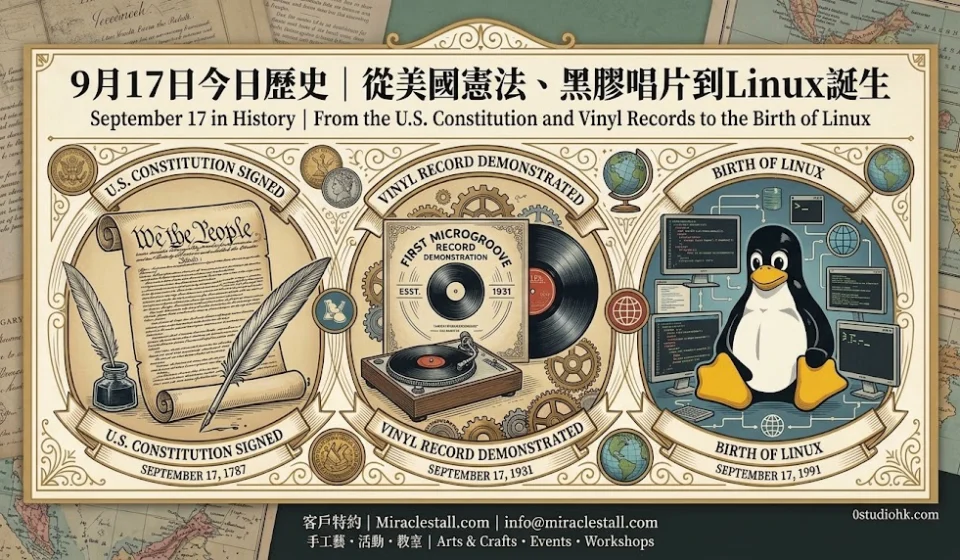
9月17日今日歷史|從美國憲法、黑膠唱片到Linux誕生|September 17 in History|From the U.S. Constitution and Vinyl Records to the Birth of Linux
9月17日見證憲政、音樂、科技、醫療與流行文化的發展,許多今天熟悉的事物都在這一天留下足跡。
September 17 connects constitutional ideas, music, technology, medicine and popular culture through milestones that still influence everyday life.
中文版本
9月17日是一個可以從「現代生活如何建立」角度閱讀的歷史日子。這一天最著名的事件之一,是1787年美國憲法在費城獨立廳正式簽署。經過數個月的討論與協商,制憲會議代表完成新的國家政府框架,39名代表在9月17日簽署最終文件。美國國家檔案館指出,這份四頁文件建立了美國聯邦政府的基本架構,而美國國會圖書館亦把9月17日列為美國憲法簽署的重要歷史日。(archives.gov) 憲法的意義並不只在於一份古老文件,而在於它提出了一套如何組織政府、分配權力及保障公共制度運作的框架。今天人們談論美國政府的行政、立法與司法制度,很多概念都可以追溯到這份文件。9月17日後來也成為美國的「憲法日」,每年提醒人們了解這份文件及其在美國公共生活中的角色。這是一個很值得從日常角度理解的歷史故事,因為制度通常不像建築物或機器那樣可以直接看見,但它卻會影響人們如何生活。9月17日另一個有趣的歷史轉折,來自音樂科技。1931年,RCA曾經展示早期33⅓轉長時間播放唱片的技術。當時的產品成本太高,未能立即成為普及商品,但這項概念後來經過改良,最終發展成我們熟悉的LP黑膠唱片。1948年,哥倫比亞唱片推出商業化的長時間播放唱片,黑膠唱片由此逐漸成為家庭音樂娛樂的重要媒介。今天很多人把黑膠唱片視為復古文化,但它曾經是非常重要的科技創新。相比早期唱片,LP能夠容納更長的音樂內容,讓一張唱片可以完整呈現一套作品,而不需要頻繁更換唱片。它不只是改善音質或播放時間,也改變了音樂產業的產品形式。唱片公司開始把專輯視為一個完整作品,歌手可以透過一張唱片建立完整的音樂概念。多年後,雖然錄音帶、CD、MP3及串流音樂相繼出現,黑膠唱片仍然沒有完全消失,反而在21世紀重新成為收藏、音響及文化生活的一部分。這正好說明一項科技即使被更新的技術取代,也可能重新獲得文化價值。9月17日也是現代科技史上的重要一天。1991年,芬蘭大學生Linus Torvalds把Linux核心最早版本0.01發布到互聯網上。Linux最初並不是一個大型商業計劃,而是一名年輕程式設計師對作業系統核心的個人興趣項目。後來Linux逐步發展成世界最重要的開源軟件項目之一,並被廣泛應用於伺服器、超級電腦、網絡設備及各種嵌入式系統。 Linux最值得注意的地方,是它展示了開源合作可以產生非常龐大的技術生態。傳統軟件通常由單一公司開發並控制,而Linux則吸引來自世界各地的程式設計師共同改善、修正和擴充。今天我們未必每天直接看到「Linux」這個名字,但很多互聯網服務、雲端運算系統、伺服器以及電子設備背後,都可能使用Linux或基於Linux的技術。從一名學生的個人項目,到支撐現代數碼世界的重要基礎設施,Linux的故事本身就是互聯網時代非常有代表性的創新故事。醫療方面,1953年9月17日也留下重要紀錄。美國紐奧良Ochsner Foundation Hospital的醫生成功把一對出生時身體連接在腰部的連體姊妹Carolyn Anne與Catherine Anne Mouton分離。相關歷史資料把這次手術列為早期成功分離連體嬰的重要醫療案例之一。 這類手術代表外科醫學、麻醉、影像技術及醫療團隊合作逐漸進步。今天醫學界可以進行非常複雜的兒童手術,但這些能力並不是突然出現,而是由一代又一代醫生透過經驗、研究與技術累積而來。9月17日亦屬於流行文化與體育世界。1923年出生的Hank Williams,是美國鄉村音樂歷史上極具影響力的歌手及詞曲作者之一。他的歌曲及演唱風格成為美國鄉村音樂發展的重要部分,並影響後來不同世代的音樂人。另一方面,1983年9月17日,Vanessa Williams成為首位非裔美國人贏得美國小姐(Miss America)冠軍,這件事在美國流行文化與社會代表性方面具有象徵意義。她後來亦發展成為歌手、演員及電視藝人,證明選美舞台並不是她事業的終點,而只是人生其中一個階段。 1920年9月17日,美國國家美式足球聯盟的前身American Professional Football Association成立,後來演變成今天的NFL。職業美式足球逐漸由地方性體育活動發展成龐大的娛樂產業,球隊、球場、電視轉播、商品及球迷文化共同形成一個全球知名的體育品牌。這個發展同樣說明,現代文化產業並不是單靠一場比賽形成,而是由媒體、商業、運動員和觀眾共同建立。 9月17日還有一項非常有趣的城市文化故事。1630年,波士頓在北美正式建立,後來逐漸成為美國重要的教育、商業與文化城市。今天人們想到波士頓,可能會聯想到大學、醫療、科技、出版及體育,但城市最初的形成同樣是一個長期發展過程。從城市建立到金融機構、教育中心和科技產業聚集,城市的身份往往經過數百年才慢慢形成。回望9月17日,可以發現這一天其實沒有單一主題,卻有一條很清楚的共同線索:人類不斷建立可以延續的系統。1787年的美國憲法建立政治制度,1931年的長時間唱片技術改變音樂保存方式,1953年的醫療手術展示外科技術進步,1983年的Vanessa Williams突破公共舞台上的代表性,1991年的Linux則展示開源合作如何改變科技世界。這些故事看似互不相關,但全部與「建立」有關。制度需要建立,音樂媒介需要建立,醫療技術需要建立,文化代表性需要逐步擴大,而開源軟件同樣需要無數人共同建立。今天我們看到的現代生活,其實就是這些不同世代的人留下的成果。9月17日因此值得記住,並不是因為它只屬於某一場著名事件,而是因為它讓我們看見制度、科技、文化和醫療如何一點一點累積,最後成為我們習以為常的世界。
English Version
September 17 provides a fascinating view of how modern society has been built through institutions, technology, medicine, music, sport and popular culture. One of the most important events associated with the date occurred in Philadelphia in 1787, when delegates to the Constitutional Convention signed the final version of the United States Constitution. After months of debate and negotiation, thirty-nine delegates signed the document on September 17. The U.S. National Archives describes the Constitution as a four-page document that established the framework of the federal government, while the Library of Congress also identifies September 17 as the date on which the final draft was signed. The importance of the Constitution goes beyond the document itself. It established a framework for organising government, distributing powers and creating institutions that could continue beyond the individuals who happened to hold office at any particular moment. Many features of the American political system can be traced back to the structure established in 1787. September 17 later became known in the United States as Constitution Day, providing an annual opportunity to learn about the document and its place in American civic life. What makes this history especially interesting is that political institutions are not always visible in everyday life. Unlike a building or a machine, a constitution cannot be physically experienced in the same way, yet its principles can influence laws, government decisions and the rights and responsibilities of citizens. Another important September 17 story belongs to the history of recorded music. In 1931, RCA demonstrated early versions of 33⅓ rpm long-playing records in New York. The technology was too expensive to become an immediate commercial success, but the basic concept later developed into the LP records that became a major part of twentieth-century music culture. In 1948, Columbia Records introduced commercial long-playing records, helping establish the LP as an important format for home listening. The LP was more than a technical improvement. Because it could contain much more music than earlier records, it encouraged musicians and record companies to think of an album as a complete artistic product. A record could have a sequence, a theme and a distinctive identity rather than simply being a collection of short songs. Later, cassette tapes, CDs, digital downloads and streaming services transformed the way people listened to music, but vinyl records never completely disappeared. In the twenty-first century, they returned as objects of collecting, high-quality listening and cultural nostalgia. This is an interesting reminder that technologies can gain new cultural meanings even after newer systems replace their original practical purpose. September 17 is also significant in the history of computing. In 1991, Finnish student Linus Torvalds released the earliest version of the Linux kernel, version 0.01, to the Internet. Linux did not begin as a major commercial project. It started as a personal interest project by a young programmer who wanted to develop a Unix-like operating system kernel. Over time, however, Linux became one of the world’s most important open-source software projects. It has been used extensively in servers, supercomputers, network equipment, cloud infrastructure and embedded devices. The most remarkable part of the Linux story is the way collaborative development transformed a small personal project into a global technological ecosystem. Instead of being controlled entirely by one company, Linux has been developed by programmers and organisations from many parts of the world. Most people may not consciously encounter the Linux name during an ordinary day, yet Linux-based systems operate behind a huge amount of Internet infrastructure and digital services. The journey from a student’s personal experiment to a major foundation of modern computing is one of the clearest examples of how open collaboration can influence technology. Medicine also has a notable place in the history of September 17. In 1953, surgeons at Ochsner Foundation Hospital in New Orleans successfully separated Carolyn Anne and Catherine Anne Mouton, conjoined twins who had been connected at the waist. Historical scientific records describe the operation as an important early example of successful separation surgery. Operations of this complexity depended on advances in surgery, anaesthesia, medical knowledge and teamwork. Modern medicine can perform extremely complicated procedures, but those abilities developed gradually through generations of research, experimentation and clinical experience. September 17 also belongs to popular culture and music. Hank Williams, born on September 17, 1923, became one of the most influential figures in the history of American country music. His songwriting, singing style and recordings helped shape the development of country music and influenced generations of musicians. The date also has a significant story of representation in American popular culture. On September 17, 1983, Vanessa Williams became the first Black woman to win the Miss America title. Her victory was significant in a country where representation on major public stages was an important social issue. Williams later built a successful career as a singer, actress and television performer, showing that the pageant was only one chapter in a much broader professional life. (history.com) The history of professional American football is also connected to September 17. In 1920, the American Professional Football Association was formed in Canton, Ohio. The organisation later became the National Football League, or NFL. What began as a collection of professional teams eventually developed into one of the world’s largest sports and entertainment industries. The growth of professional football involved much more than the sport itself. Stadiums, broadcasting, advertising, merchandise, sponsorship and fan culture all contributed to its transformation into a major commercial and cultural phenomenon. (profootballhof.com) September 17 also has a story about cities and urban development. Boston was founded in 1630 and gradually developed into one of the most important centres of education, medicine, business and culture in the United States. Modern Boston is strongly associated with universities, hospitals, technology companies and professional sports, but its identity was built over centuries. Cities rarely become major cultural or economic centres overnight. Their character develops through institutions, communities, industries and generations of residents. When the events of September 17 are considered together, an interesting theme emerges: the human ability to build systems that survive beyond the moment in which they were created. The Constitution established a political framework. Long-playing records changed the way music could be stored and experienced. Medical advances expanded what surgeons could accomplish. Vanessa Williams’ achievement changed perceptions of representation on a major cultural stage. Linux demonstrated how an international community could build and maintain important software through open collaboration. Professional football developed into a huge entertainment system connecting athletes, audiences and businesses. These stories are very different, but they all involve construction and development. Institutions have to be built. Technologies have to be refined. Cultural representation changes gradually. Medical knowledge accumulates through experience. Software ecosystems grow through collaboration. The modern world is therefore not the result of one invention or one historic decision. It is the accumulated product of countless people building, testing, improving and sometimes rethinking the systems around them. September 17 offers a useful reminder of this process. Some historical changes are dramatic and immediately visible, while others begin quietly as a document, a technical experiment, a medical procedure, a musical format or a small software project. Their importance becomes clear only later. The Constitution became a foundation of American government. The LP became one of the defining formats of twentieth-century music. Linux became part of the infrastructure of the digital age. Medical techniques once considered extraordinary gradually became part of modern surgical knowledge. Cultural milestones such as Vanessa Williams’ achievement contributed to broader discussions of representation and opportunity. Looking back at September 17 therefore allows us to see history from a different perspective. Instead of asking only which famous event happened on a particular date, we can ask what systems, ideas and innovations were being created. That question often reveals a deeper connection between the past and the present. Many things that seem completely ordinary today were once new and uncertain. A constitution was once a proposal. A record album was once an experimental format. Open-source software was once a personal project. Complex surgery was once far beyond ordinary medical capability. A major cultural stage once had barriers that later generations would challenge. History is the story of how these possibilities gradually changed. September 17 is therefore a day about building the foundations of modern life—through government, technology, medicine, music, sport and culture.
總評
9月17日從憲法、音樂科技、醫療到Linux與文化代表性,展示制度與創新如何逐步建立今天的世界。
September 17 shows how institutions, technology, medicine and culture gradually built many of the foundations of modern life.