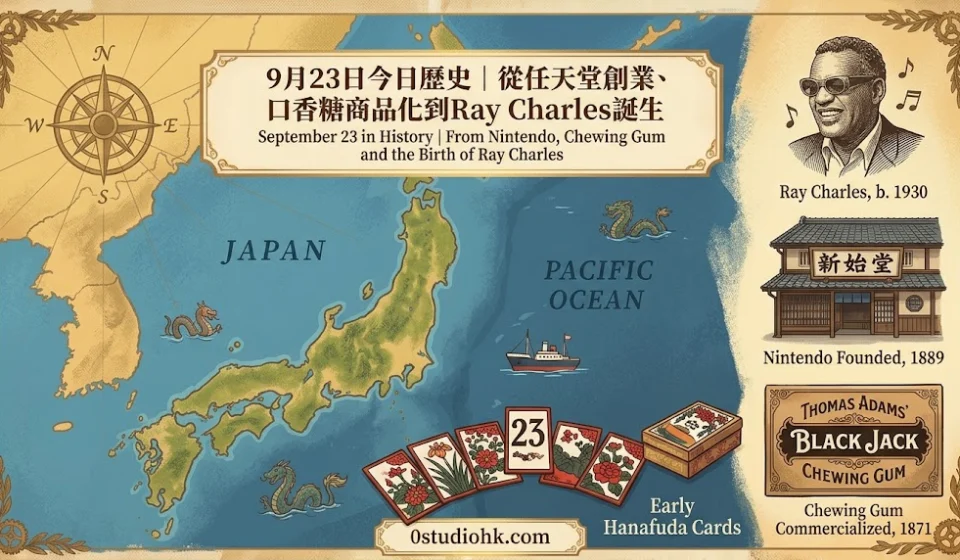
9月23日今日歷史|從任天堂創業、口香糖商品化到Ray Charles誕生|September 23 in History|From Nintendo, Chewing Gum and the Birth of Ray Charles

9月23日把遊戲、日常消費與音樂文化連在一起,從京都的花札,到第一款商業口香糖,再到Ray Charles的音樂人生。
September 23 connects games, everyday products and music culture, from Japanese playing cards and commercial chewing gum to the remarkable musical life of Ray Charles.
中文版本
9月23日是一個充滿生活文化氣息的日子,從一間京都小店開始的花札生意,到一塊可以咀嚼的樹脂產品,再到一位改變現代音樂的歌手,這一天的歷史提醒我們,很多後來影響世界的事物,最初都可能非常普通。1889年9月23日,山內房治郎在日本京都開始製造和銷售花札(Hanafuda)紙牌,這也是今天任天堂歷史的起點。任天堂官方公司歷史資料指出,山內房治郎當年在京都下京區開始製造日本紙牌,後來逐步擴展業務。今天的Nintendo已經是全球知名的電子娛樂公司,但它最初並不是遊戲機企業,而是一家製造傳統紙牌的商店。 花札本身是一種日本傳統紙牌遊戲工具,以月份和季節相關的圖案組成牌面,不同牌組之間可以進行不同遊戲。任天堂後來經歷多次業務轉型,1902年開始製造及銷售日本的西式撲克牌,1953年成為日本第一家成功大量生產塑膠撲克牌的公司,1959年更推出使用Disney角色的撲克牌。這些改變反映一間企業如何隨著市場與消費文化變化而重新定位。 任天堂直到20世紀後半才逐漸進入玩具及電子娛樂領域,最後成為大家熟悉的遊戲公司。因此,如果只從今天的Nintendo去看,很容易忘記它其實有超過一百三十年的歷史,而最早的產品與今天的Switch、遊戲軟件及電子娛樂幾乎沒有直接關係。這段歷史最有趣的地方,是「品牌」並不是一開始就決定好的。企業可以從紙牌開始,經過塑膠產品、玩具,再進入電子遊戲,最後形成一個全球文化品牌。這種長時間的轉型,也說明商業歷史並不是一條直線,而是一個不斷試驗、調整與尋找新市場的過程。9月23日另一個有趣的故事,來自1848年的美國。這一天,John B. Curtis開始出售被廣泛認為是第一種商業化生產並以品牌形式出售的口香糖,名稱是“The State of Maine Pure Spruce Gum”。Guinness World Records將Curtis列為第一種品牌商業口香糖的製作者。 當時的口香糖與今天超級市場貨架上的產品非常不同。Curtis利用雲杉樹脂製作可以咀嚼的物質,之後再透過加入其他成分改善口感與產品特性。這個看似簡單的產品,其實反映19世紀工業化社會的一個重要轉變:原本存在於自然環境或地方生活中的東西,可以經過加工、包裝、命名與銷售,變成一種可以大量交易的消費產品。 口香糖的歷史也很有意思,因為「咀嚼」本身並不是現代發明。不同地區的人類早已經有咀嚼樹脂、植物材料或其他天然物質的習慣。真正發生改變的是商業模式。當產品開始有品牌、有包裝、有固定配方,而且可以在商店出售,原本很普通的生活習慣就逐漸變成一個產業。這也是現代消費文化形成的一部分。今天我們在便利店、超市或自動售賣機看到一包口香糖,可能只會把它視為幾元錢的小商品,但它其實代表了一條很長的商品發展歷史:原料、加工、味道、包裝、品牌、分銷以及消費者習慣,每一部分都可以影響產品最後能否成功。9月23日同時也是美國音樂家Ray Charles的生日。1930年,他出生於美國喬治亞州Albany,原名Ray Charles Robinson,後來成為20世紀美國音樂史上非常重要的歌手、鋼琴家及作曲家。Ray Charles官方網站介紹,他在1950年代推動Soul音樂發展,把Blues、Gospel、R&B、Rock、Country與Jazz等不同元素結合,形成具有自己特色的音樂風格。 Ray Charles的成長經歷並不容易。他年幼時開始接觸音樂,在五歲前已經學習鋼琴;六歲左右開始受到青光眼影響,之後逐漸失去視力。他曾在佛羅里達州St. Augustine的聾人及盲人學校學習,在那裡學習以Braille閱讀和書寫音樂,同時接觸鋼琴、單簧管等樂器。 他的故事並不只是「一位失明音樂家的成功故事」,更重要的是他如何把不同音樂傳統重新組合。Gospel原本具有宗教音樂背景,Blues與R&B則有不同的社會與音樂傳統,Country、Jazz與Rock又各自擁有不同的聽眾。Ray Charles把這些元素放在一起,讓不同音樂類型之間產生新的連接。這種融合後來成為Soul音樂發展的重要部分,也影響了之後許多歌手和音樂製作人。 9月23日還與另一種非常不同的文化產品有關。1962年9月23日,美國ABC電視台首播Hanna-Barbera製作的動畫《The Jetsons》。雖然這部動畫以未來生活為背景,但它真正有趣的地方並不是「預測未來是否準確」,而是它把當時人們對未來家庭生活的想像畫成了日常喜劇。Television Academy資料指出,《The Jetsons》於1962年9月23日首播,並成為ABC早期彩色電視節目的代表之一。 家庭電器、自動化、機械助手、快速交通以及充滿科技感的住宅,都成為動畫中的生活元素。很多想像與今天真正的科技並不完全相同,但它反映了1960年代社會對科技進步的樂觀想像。這與任天堂的歷史又產生一個有趣的連接:一方面,任天堂從傳統紙牌逐步進入電子娛樂;另一方面,電視動畫則把未來科技想像帶進普通家庭。兩者都說明娛樂文化不只是消磨時間,也會影響人們如何想像未來。 如果把9月23日的幾段歷史放在一起看,可以看到一個很清楚的共同點:很多改變世界的東西,最初都是生活中的小事。花札是一副紙牌,口香糖是一種可以咀嚼的產品,音樂則只是聲音與節奏的組合,但當有人重新設計、重新組合,或者找到新的方式讓更多人接觸,它們就可能產生遠超原本用途的文化影響。任天堂由紙牌商店變成全球遊戲品牌,口香糖由天然樹脂變成現代消費商品,Ray Charles把不同音樂傳統融合成新的聲音,而《The Jetsons》則把科技想像變成一種流行文化。這些故事都說明,創新未必一定來自一個驚天動地的發明。有時候,真正的變化只是把一件已經存在的東西,用另一種方法重新做一次。今天我們看到Nintendo、商業品牌、流行音樂與動畫時,很容易只看到它們現在的規模,卻忘記它們都有一個很小的起點。9月23日因此可以被看成一個「小東西如何變成大文化」的日子。一副紙牌可以成為一個百年品牌的起點,一塊樹脂可以成為全球消費產品,一位年輕音樂家的學習可以改變音樂史,而一套動畫對未來家庭的想像,也可以留下幾代人的共同記憶。歷史真正有趣的地方,也許正是我們永遠不知道今天看似普通的東西,未來會不會成為另一個時代的重要文化符號。
English Version
September 23 brings together several stories that appear unrelated at first: a traditional Japanese card business, the commercialisation of chewing gum, the birth of a major musician and the arrival of a futuristic animated television family. Together, however, they reveal something important about cultural history: many things that eventually become globally recognised begin as small, ordinary ideas. On September 23, 1889, Fusajiro Yamauchi began manufacturing and selling Japanese playing cards known as Hanafuda in Kyoto. Nintendo’s official corporate history identifies this period as the beginning of the company’s long history. Today Nintendo is one of the world’s best-known entertainment companies, associated with video games, consoles and characters recognised across generations. Yet its original business had nothing to do with electronic games. It began with traditional playing cards. Hanafuda cards use colourful images connected with the months and seasons, and they became part of Japanese gaming culture. Nintendo’s later history shows how dramatically a company can change while retaining a connection with entertainment. In 1902, the business began producing and selling Western-style playing cards in Japan. In 1953, it became the first company in Japan to successfully mass-produce plastic playing cards, and in 1959 it began selling playing cards featuring Disney characters. These developments show that Nintendo did not move directly from playing cards to modern video games. Instead, it experimented with different products and markets over many decades. The company eventually entered toys and electronic entertainment before becoming the Nintendo known around the world today. This long history is important because modern brands can easily appear as if they were created with their final purpose already in mind. Nintendo is a good example of the opposite. A company can begin with one product, respond to changes in consumer behaviour, explore new technologies and gradually build a completely different identity. Business history is therefore rarely a straight line. It is usually a process of experimentation, adaptation and reinvention. September 23 also takes us into a very different part of everyday life: chewing gum. On September 23, 1848, John B. Curtis began selling what is widely regarded as the first commercially produced branded chewing gum, called “The State of Maine Pure Spruce Gum”. Guinness World Records identifies Curtis as the producer of the first branded, commercially produced chewing gum. The product was made from spruce resin and was developed into something that could be manufactured and sold to consumers. The idea of chewing natural materials, of course, was much older than the nineteenth century. People in different parts of the world had long chewed various natural resins and plant materials. What changed in the nineteenth century was the commercial system surrounding the product. Once a material could be processed, packaged, given a name and sold consistently, an everyday habit could become a consumer industry. The history of chewing gum is therefore more than a curiosity about a familiar sweet. It illustrates how modern consumer culture developed. A successful product depends on much more than the raw material. Taste, texture, packaging, branding, distribution, price and consumer habits all influence whether something becomes commercially successful. Today a packet of chewing gum in a supermarket or convenience store may seem like a very small purchase, but behind it is a long history of manufacturing and marketing. The story also demonstrates how industrialisation transformed ordinary habits into organised businesses. A natural substance that once had a local or informal use could eventually become a branded product available to a much wider population. September 23 is also the birthday of one of the most influential musicians in modern American music: Ray Charles. Born Ray Charles Robinson on September 23, 1930, in Albany, Georgia, he became a pioneering musician whose work helped shape soul music. His official biography describes how he combined blues, gospel, R&B, rock, country and jazz to create a distinctive musical style. Charles encountered music at a very young age and began playing the piano before he was five. When he was around six, glaucoma began affecting his eyesight, and he eventually became blind. He attended the Florida School for the Deaf and Blind in St. Augustine, where he learned to read and write music in Braille and studied several instruments, including piano and clarinet. His importance is not simply the story of a blind musician who achieved success. His deeper contribution was the way he connected musical traditions that had often been treated as separate. Gospel, blues, rhythm and blues, country, jazz and rock each had different histories and audiences. Charles brought elements of these traditions together and helped create a sound that crossed musical boundaries. His work became an important part of the development of soul music and influenced generations of performers. September 23 also has a place in television history. On September 23, 1962, Hanna-Barbera’s animated sitcom The Jetsons premiered on ABC. Television Academy records the premiere date and describes the programme as one of the early colour television programmes on the network. The series imagined an ordinary family living in a highly technological future, with automated household devices, unusual forms of transport, mechanical assistants and futuristic homes. Not all of its predictions became reality, but that was not necessarily the point. The Jetsons captured the optimism of the early 1960s and turned ideas about technological progress into everyday comedy. Its popularity also demonstrated how entertainment can influence the way people imagine the future. A television programme does not need to predict technology accurately to shape cultural expectations. It can simply create images of what life might look like and allow audiences to imagine themselves living in that world. This creates an interesting connection with Nintendo’s history. Nintendo began with a traditional form of entertainment and gradually moved towards electronic entertainment, while The Jetsons used television to imagine what technology might bring to everyday life. Both stories demonstrate that entertainment is not merely about passing time. It can also influence how people understand technology, family life and the future. When the events of September 23 are viewed together, a common pattern emerges. A deck of cards, a piece of chewing gum, a musical performance and an animated television programme may seem like very small things compared with major political or economic events. Yet each became part of a much larger cultural story. Nintendo grew from a traditional card business into a global entertainment company. Chewing gum developed from natural resin and an old habit into a modern consumer product. Ray Charles transformed musical influences from different traditions into a distinctive sound. The Jetsons turned technological optimism into a shared cultural image of the future. None of these developments required the invention of an entirely new human activity. Instead, they often involved taking something that already existed and finding a new way to make it, sell it, combine it or present it. That is an important lesson about innovation. Innovation is not always a dramatic invention that appears suddenly. Sometimes it is a gradual process of changing an existing idea until it becomes something different. The history of Nintendo is a particularly strong example. Its original product and its modern products are separated by more than a century of business experimentation. The company survived because it was able to change. The history of chewing gum tells a similar story at a smaller scale: the act of chewing was ancient, but commercial production created a new market. Ray Charles shows the same principle in music: the individual musical traditions already existed, but combining them in a new way created something distinctive. The Jetsons did something similar with technology and entertainment by combining familiar family life with imaginative ideas about the future. September 23 can therefore be remembered as a day of cultural transformation. It reminds us that the things we take for granted often have surprisingly long histories. A card game can become the beginning of a global brand. A small consumer product can develop into an international industry. A musician can connect traditions and influence generations. A television cartoon can leave behind images that become part of popular culture. History is not only made by large institutions or dramatic events. It is also made by ordinary objects, creative people and small ideas that find a way to reach a much larger audience. That may be the most interesting lesson of September 23: we can never be completely certain which ordinary idea of today will become an important cultural symbol of tomorrow.
總結
9月23日展示了「小事變成大文化」的過程:紙牌成就任天堂、樹脂成為商品、音樂跨越界線,而動畫則把未來想像留在人們記憶中。
September 23 shows how small ideas can become major parts of culture: cards led to Nintendo, resin became a consumer product, music crossed boundaries, and animation turned ideas about the future into shared memories.