
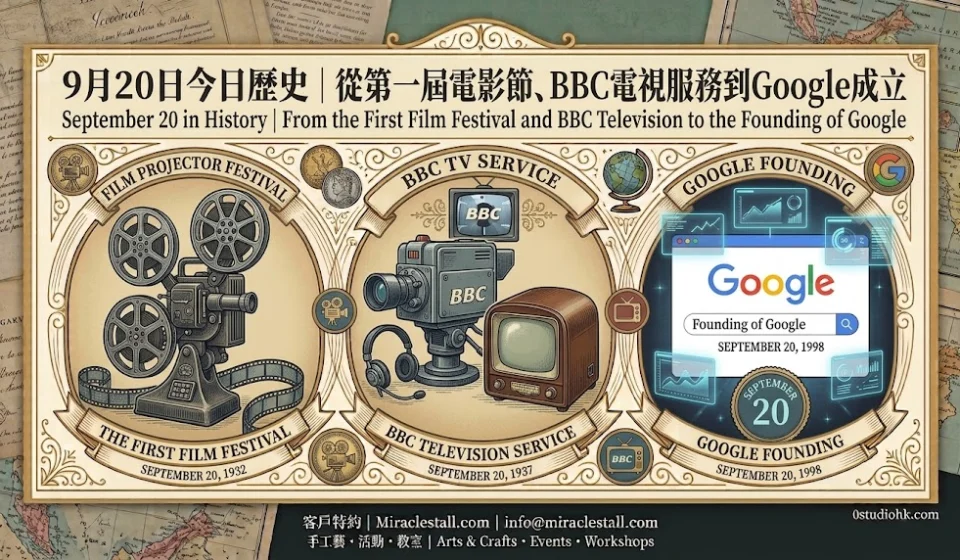
9月20日今日歷史|從第一屆電影節、BBC電視服務到Google成立|September 20 in History|From the First Film Festival and BBC Television to the Founding of Google
9月20日見證電影、廣播、電視、網絡與商業創新的發展,記錄人類如何改變資訊與娛樂方式。
September 20 connects cinema, broadcasting, television, the Internet and business innovation in the evolution of modern communication and entertainment.
中文版本
9月20日是一個充滿文化與科技氣息的歷史日子。這一天的故事,沒有必要只從政治或衝突角度理解,因為它同樣記錄了電影節、廣播、電視、搜尋引擎、商業創新及大眾娛樂的發展。1920年9月20日,意大利威尼斯舉行第一屆威尼斯國際電影節,這個電影節後來成為世界最具代表性的電影活動之一。威尼斯電影節不只是電影上映的地方,也逐漸成為導演、演員、製片人、影評人與觀眾交流的平台。電影由單純的娛樂作品,慢慢發展成為可以代表文化、藝術與社會觀念的重要媒介。今天世界各地都有電影節,而威尼斯電影節的歷史正好反映電影如何由早期的新興娛樂,逐步成為全球文化產業的重要一部分。9月20日同樣與英國廣播及電視發展有關。1928年,英國廣播公司BBC開始進行早期電視實驗,而1936年BBC正式推出世界上最早期的 नियमित公共電視服務之一。電視的出現改變了家庭娛樂方式,新聞、戲劇、音樂、體育及教育節目可以直接進入客廳。與報紙及廣播相比,電視增加了影像元素,使觀眾不但可以聽到消息,也可以看到事件與人物。這種視覺媒體後來成為20世紀最重要的大眾文化工具之一。9月20日也可以從科技與互聯網角度理解。1998年9月4日,Larry Page與Sergey Brin正式成立Google,而到了1998年9月下旬,公司開始快速發展。Google最初只是一個搜尋引擎,但它後來逐步成為全球最重要的互聯網服務公司之一。搜尋引擎最大的改變,是讓互聯網上的大量資訊變得可以被快速尋找。早期網絡上的資訊雖然很多,但如果沒有有效的搜尋工具,用戶很難找到需要的內容。Google透過分析網頁之間的關係及建立搜尋排名,改善了人們尋找資訊的方式。今天我們搜尋一個問題、地點、人物或商品,往往只需要幾秒鐘,這種習慣其實改變了人類獲取知識的方式。9月20日也屬於現代商業及消費文化。1973年,著名的「古馳」Gucci創辦人之一Guccio Gucci的品牌影響力已經逐漸擴大,時裝、皮革製品及奢侈品牌文化開始成為全球消費文化的一部分。雖然品牌的創立並不完全發生於9月20日,但這一天的歷史人物與商業事件中,也可以看到20世紀品牌文化如何逐步成熟。品牌不再只是商品名稱,而是透過設計、包裝、店舖形象與名人文化建立身份。今天人們購買一件產品,有時不只是購買它的功能,也是在購買一種風格、故事及生活想像。這種現代品牌文化,正是20世紀消費社會發展的重要部分。9月20日還是美國小說家Upton Sinclair出生的日子。1878年出生的Sinclair,最著名作品之一是1906年的《The Jungle》。這本小說透過芝加哥肉類加工業工人的生活,揭示當時食品工業及勞工環境存在的問題,出版後引起廣泛社會討論,並推動美國食品安全及消費者保護改革。這個故事非常值得從「普通人的生活」角度理解,因為一部小說不一定只提供娛樂,也可以令社會重新注意一些原本被忽略的問題。文學因此不只是故事,而可以成為公共討論的一部分。9月20日也與世界兒童文化有關。1934年出生的Sophia Loren,後來成為意大利最著名的電影明星之一。她的電影生涯跨越數十年,並成為歐洲電影走向國際的重要代表人物之一。她的成功也反映戰後電影工業與國際娛樂市場逐漸擴大,演員可以突破本地市場,在不同國家建立知名度。除了電影之外,9月20日還有另一個重要的文化故事:1990年,美國電視動畫《The Fresh Prince of Bel-Air》開始播出。這套作品後來成為90年代重要的流行文化節目之一,並讓Will Smith從音樂人逐漸成為全球知名演員。節目以一名年輕人搬到富裕親戚家中生活為背景,透過喜劇處理家庭、階級、成長、文化差異與身份等問題。這類電視節目說明娛樂作品可以在輕鬆的形式下討論社會現實。回望9月20日,可以看到一條非常清晰的共同線索:資訊與文化的傳播方式不斷改變。電影節讓不同國家的電影聚集在同一個城市;廣播和電視把聲音與影像帶進家庭;小說把社會問題帶給大眾;Google則讓互聯網上的資訊可以被快速搜尋;電視喜劇又把文化與社會議題帶到普通家庭的客廳。這些事件看似分散,但其實都與「人如何接收資訊與故事」有關。從電影院到電視機,再到電腦與搜尋引擎,人類一直在尋找更有效的方法去觀看、聆聽、閱讀和理解世界。今天我們可以在手機上觀看電影、搜尋新聞、閱讀小說、觀看電視劇,甚至透過串流平台在任何時間觀看過去幾十年的作品。這種生活方式並不是突然出現,而是由電影、廣播、電視、出版業及互聯網一步一步建立起來。9月20日因此值得記住,因為它提醒我們,現代文化並不只是由名人或熱門作品組成,更由一套套傳播技術與平台支撐。當新的媒體出現,人的生活方式也會隨之改變。電影讓故事可以被大量複製與觀看,電視讓影像進入家庭,互聯網讓資訊可以即時搜尋,而今天的串流與社交平台則進一步打破時間與地域限制。從這個角度看,9月20日其實是一個關於「文化如何流動」的日子。電影、文學、電視和互聯網雖然使用不同技術,但最終都是把人的思想、故事和資訊傳遞給其他人。這種傳遞能力不斷提升,也逐漸改變了整個世界。歷史有時候最有趣的地方,就在於我們今天習以為常的事情,曾經都是令人驚訝的新技術。當第一批電視觀眾坐在家中觀看影像時,電視是一項革命性發明;當早期網民第一次利用搜尋引擎尋找資料時,搜尋引擎是一種全新的工具;而今天我們用手機幾秒鐘找到世界另一端的資料,卻已經覺得理所當然。9月20日所留下的故事,正好讓我們看見這條由傳統媒體走向數碼世界的漫長道路。
English Version
September 20 offers a fascinating journey through cinema, broadcasting, television, literature, the Internet and popular culture. Rather than focusing only on political events, the date allows us to examine how people gradually developed new ways to tell stories, share information and experience entertainment. One of the most important cultural milestones connected with September 20 is the Venice International Film Festival, which began in 1932 and eventually became one of the world’s most prestigious film festivals. Venice helped establish the idea that cinema could be more than commercial entertainment. Films could also be treated as artistic and cultural works, while festivals could bring filmmakers, actors, producers, critics and audiences together in the same place. The development of major film festivals reflected the growing importance of cinema during the twentieth century. Film eventually became a global language capable of crossing national and linguistic boundaries. A story created in one country could be watched and appreciated by audiences thousands of miles away. September 20 also provides a useful connection with the history of British broadcasting and television. The BBC conducted early television experiments during the late 1920s, and in 1936 it launched one of the world’s earliest regular public television services. Television transformed domestic entertainment. Newspapers delivered printed information, and radio brought voices and music into the home, but television added moving images. Audiences could now watch news, drama, sport, music and educational programmes from their living rooms. The arrival of television therefore changed not only entertainment but also the rhythm of family life. People began organising parts of their evenings around scheduled programmes, and television gradually became one of the defining mass-media technologies of the twentieth century. September 20 can also be viewed through the development of the Internet and search technology. Google was formally founded in September 1998 by Larry Page and Sergey Brin. What began as a search engine eventually developed into one of the most influential Internet companies in the world. The importance of search engines is easy to underestimate because searching for information now feels completely natural. In the early days of the Web, however, finding useful information among a rapidly growing number of pages was much more difficult. Search technology made the Internet significantly more practical by helping users locate relevant information quickly. Google developed methods for analysing relationships between web pages and ranking results, contributing to a new way of navigating online information. Today, a person can search for a historical fact, restaurant, product, person or location within seconds. This has changed the relationship between people and knowledge. Information is no longer something that must always be physically located in a book, library or newspaper archive. Much of it can be reached almost instantly through a connected device. September 20 also reflects the development of modern consumer and brand culture. During the twentieth century, companies increasingly realised that a product could represent more than its practical function. Design, packaging, advertising, shops and celebrity associations could give a product a distinct identity. Luxury brands such as Gucci became part of this broader transformation in consumer culture, demonstrating how fashion and design could create powerful international identities. People do not always purchase a branded product simply because it performs a particular function. They may also be buying an image, a style, a story or a sense of belonging. This transformation helped create the modern concept of the global lifestyle brand. Literature provides another important September 20 connection. American writer Upton Sinclair was born on September 20, 1878. His best-known novel, “The Jungle,” published in 1906, examined the harsh conditions experienced by workers in Chicago’s meatpacking industry. The book attracted enormous public attention and helped generate concern about food production, working conditions and consumer protection. Sinclair’s experience demonstrated that literature could influence public debate. A novel did not have to exist only for entertainment. It could also reveal problems that many people had not fully understood and encourage society to demand change. This remains an important role for journalism, documentary filmmaking, literature and other forms of public storytelling today. September 20 also has a connection with international cinema through Sophia Loren, who was born in 1934 and became one of Italy’s most internationally recognised actresses. Her career lasted for decades and helped demonstrate how European cinema could produce stars with global audiences. The international success of actors such as Loren reflected the growing connections between national film industries, international distribution and global popular culture. Cinema was becoming increasingly international, and audiences were becoming more willing to watch stories and performances from outside their own countries. Popular television provides another September 20 story. In 1990, “The Fresh Prince of Bel-Air” premiered in the United States. The sitcom became an important part of 1990s popular culture and helped transform Will Smith from a successful musician into a major international actor. The programme followed a young man who moved in with wealthy relatives in Bel-Air and used comedy to explore family relationships, social class, identity, growing up and cultural differences. Its success demonstrated that television comedy could entertain audiences while also discussing real social questions. The stories associated with September 20 therefore share a surprisingly clear theme: communication and cultural circulation. Film festivals bring stories from different countries together. Television brings images and narratives into people’s homes. Literature can expose social problems and influence public discussion. Search engines make enormous quantities of information easier to access. Television programmes can turn social experiences into stories that millions of people share. These developments may seem unrelated, but they all concern the way people receive, interpret and exchange information. Human beings have continually searched for better ways to watch, listen, read and understand the world around them. The path from cinema screens to television sets, from printed books to search engines and from scheduled broadcasts to streaming services represents a long history of technological and cultural adaptation. Today, a person can watch a film on a phone, search for information online, read an e-book and stream a television series at almost any time. None of this appeared suddenly. It was built through generations of experimentation in cinema, broadcasting, publishing, computing and telecommunications. September 20 is therefore worth remembering because it shows that modern culture depends not only on famous creators and performers but also on the technologies and institutions that allow their work to reach audiences. When a new medium appears, it changes more than the way information is delivered. It can change how people organise their time, how businesses operate and how societies share experiences. Early television audiences could not have imagined the enormous number of channels and services available today. Early Internet users could not have imagined a world where search engines could answer questions within seconds. Early film audiences could not have imagined that cinema would become a global industry capable of reaching billions of people. Each generation becomes accustomed to technologies that once seemed extraordinary. This is one of the most interesting lessons of September 20. History is not simply about old objects and famous names. It is also about the systems that gradually become invisible because they work so well. The cinema, television, newspaper, radio and Internet have all changed dramatically, yet their basic purpose remains remarkably consistent: connecting people with information, stories and ideas. The technology changes, but the human desire to communicate remains. September 20 therefore offers a snapshot of the long journey from traditional media to the digital world. It reminds us that the modern information environment was built one innovation at a time, and that today’s apparently effortless access to culture and knowledge is the result of more than a century of technological and creative development.
總評
9月20日從電影、電視、文學到互聯網,展示資訊與娛樂媒介如何逐步改變人類接收世界的方式。
September 20 shows how cinema, television, literature and the Internet gradually transformed the way people receive information, stories and entertainment.