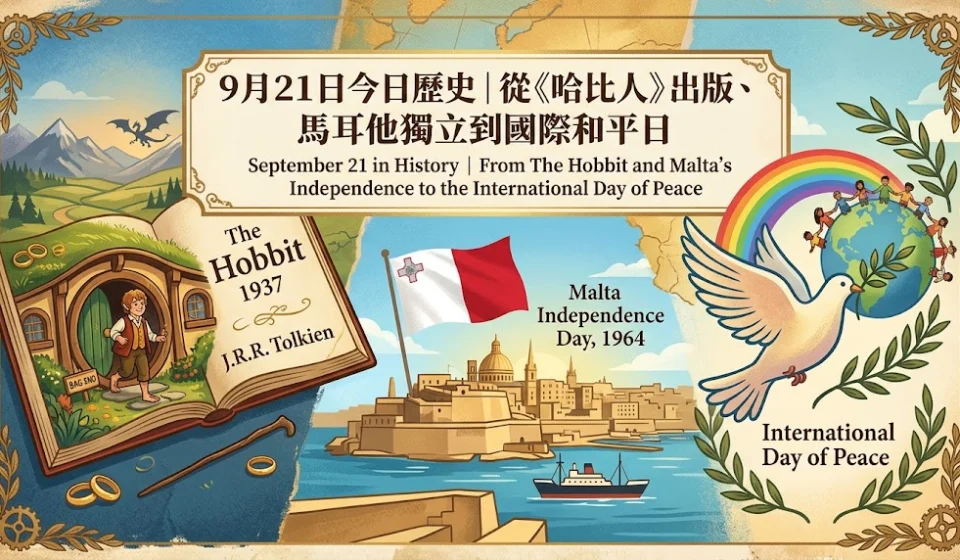
9月21日今日歷史|從《哈比人》出版、馬耳他獨立到國際和平日|September 21 in History|From The Hobbit and Malta’s Independence to the International Day of Peace

9月21日把文學、國家獨立與和平理念放在同一天,從中土世界到現實世界,都提醒我們改變可以由一個故事、一個決定開始。
September 21 connects literature, national independence and the idea of peace, reminding us that change can begin with a story, a decision or a shared commitment.
中文版本
9月21日,是一個很適合從「人如何建立自己的世界」去理解的日子。1937年9月21日,英國作家J.R.R.托爾金的《哈比人,或一路來回》正式出版,第一版由George Allen & Unwin出版,首刷只有1,500本,托爾金本人還為作品繪製插圖。這本原本面向兒童讀者的奇幻小說,後來成為20世紀英語文學中最具影響力的作品之一,也成為後來《魔戒》世界的重要起點。故事主角比爾博・巴金斯原本只想過著安靜、舒適的生活,卻因甘道夫與矮人來訪而踏上一段完全超出自己日常生活範圍的旅程。從出版史來看,《哈比人》的意義不只在於創造了一個奇幻世界,更在於它證明一本書可以由一個相對簡單的故事開始,逐步形成龐大的文化現象。第一版很快售罄,出版社其後再版,作品的讀者群亦逐漸擴大。今天我們熟悉的中土世界、哈比人、精靈、矮人以及其他幻想元素,很多都可以追溯到這本1937年的作品。 如果說《哈比人》代表的是「用故事創造一個世界」,那麼1964年9月21日的馬耳他獨立,則代表一個地方開始以自己的身份走向世界。馬耳他政府資料顯示,George Borg Olivier在推動獨立過程中,最終把9月21日定為獨立日;1964年這一天,馬耳他正式成為獨立國家,並留在英聯邦之內。獨立之後,馬耳他仍然面對如何建立自己的政治、經濟與社會身份等問題,而今天的9月21日仍然是馬耳他的國定假日。 這段歷史值得注意的地方,是「獨立」並不是一個日期完成所有事情,而是一個社會重新思考自己如何運作的開始。國家名稱、政府制度、法律、公民身份、語言、經濟方向,以至人民對自身文化的理解,都會隨著政治身份改變而重新整理。馬耳他面積不大,卻位於地中海重要位置,歷史上長期受到不同文化影響,因此它的獨立故事也可以看成一個小型社會如何在多重文化之間建立自己的身份。今天的馬耳他同時保留馬耳他語與英語的官方地位,語言本身也成為身份的一部分。 9月21日另一個重要主題,是聯合國國際和平日。聯合國在1981年通過第36/67號決議,最初把和平日安排在每年9月的第三個星期二;1982年首次紀念。到了2001年,聯合國大會通過第55/282號決議,把9月21日正式確立為國際和平日,並將這一天定為非暴力與停火的日子。 2026年的國際和平日主題是「Invest in Peace: For Everyone, Everywhere, Every Day」,聯合國特別強調和平並不只是沒有戰爭,而是與安全、尊嚴、機會、合作以及日常生活息息相關。換句話說,和平並不是一個只屬於國際政治或外交場合的抽象概念,也可以出現在家庭、學校、社區、工作場所,以及人與人之間的日常互動。 這一點其實與《哈比人》的故事形成有趣對照。托爾金筆下的比爾博開始時只是一個喜歡安穩生活的普通人物,後來才發現世界比自己的家門大得多;而現實世界中的人,也往往是在社會、國家與文化發生變化時,才重新思考自己與世界的關係。9月21日也與幾位文化人物的生日有關。1934年出生的Leonard Cohen,後來成為加拿大著名歌手、詞曲作者與詩人,他的作品跨越音樂與文學;1947年出生的Stephen King則成為20世紀後期最具知名度的小說家之一,作品長期影響恐怖、驚悚與流行文化。 同一個日期,既可以記住一本小說的誕生,也可以記住一個國家取得獨立,還可以思考一個國際社會希望共同追求的和平理念。歷史有時並不是一連串巨大的事件,而是許多不同方向的小故事在同一天交會。一本書可以改變文學,一個國家可以重新定義自己的身份,一個國際日則可以提醒世界某些價值不能只停留在口號。9月21日真正有意思的地方,正是它把「想像世界」、「建立身份」與「共同生活」三件事情放在一起。從比爾博走出家門,到馬耳他走向獨立,再到聯合國把和平變成一項每年提醒世界的公共理念,這一天告訴我們,世界的改變未必總是由巨大的力量開始。有時候,它只是源於一個人寫下一個故事、一個社會決定重新定義自己,或者一群人願意相信彼此可以用不同的方法共同生活。
English Version
September 21 is a date that brings together literature, national identity and the idea of peace. One of its most memorable cultural milestones came in 1937, when J.R.R. Tolkien’s The Hobbit, or There and Back Again was published in Britain. George Allen & Unwin released the first edition on September 21, 1937, with an initial print run of only 1,500 copies. Tolkien also provided illustrations for the book himself. What began as a fantasy story aimed largely at younger readers would eventually become one of the most influential works of twentieth-century English-language fantasy and the foundation for the much larger world that Tolkien later developed in The Lord of the Rings. The story follows Bilbo Baggins, a quiet and comfort-loving hobbit whose ordinary life is interrupted when Gandalf and a group of dwarves arrive at his home and invite him on an unexpected journey. Bilbo initially seems like the least likely person to become an adventurer. He prefers familiar surroundings, regular meals and the security of home. Yet the journey gradually changes his understanding of himself and the world beyond his front door. The importance of The Hobbit therefore goes beyond its fantasy creatures and adventure. It demonstrated how a relatively simple story could develop into an enormous cultural world. The first edition quickly sold out, leading to further printings and a growing readership. The book introduced or popularised many elements that would become closely associated with Tolkien’s Middle-earth, including hobbits, dwarves, elves, dragons and a detailed mythology behind the characters and landscapes. The first printing contained only 1,500 copies, making its later cultural influence particularly remarkable. September 21 also marks a very different kind of transformation: Malta’s independence. On September 21, 1964, Malta became an independent state after a period of British rule. The Maltese government records that Prime Minister George Borg Olivier selected September 21 as Independence Day during the process of preparing the country for independence. Malta became a sovereign independent nation within the Commonwealth, and the date remains one of the country’s national holidays. Independence did not mean that every question about Malta’s future was suddenly solved. Instead, it began a new stage in which the country had to develop its own political institutions, economic direction and sense of national identity. Questions of citizenship, language, culture and international relationships became part of the continuing story of an independent Malta. The country’s geographical position in the Mediterranean has also contributed to a history shaped by different cultural influences. Malta’s modern identity therefore reflects several layers of history rather than a single tradition. Its language is part of that identity as well: Maltese is the national language, while Maltese and English have official status, alongside Maltese Sign Language. September 21 has another important meaning around the world because it is the United Nations International Day of Peace. The United Nations General Assembly established the International Day of Peace in 1981 through Resolution 36/67. At first, the day was connected with the opening of the General Assembly and was observed on the third Tuesday of September. The first Peace Day was observed in 1982. In 2001, the General Assembly adopted Resolution 55/282 and permanently established September 21 as the International Day of Peace, designating it as a day associated with non-violence and ceasefire. In 2026, the United Nations is marking the day under the theme “Invest in Peace: For Everyone, Everywhere, Every Day”. The message emphasises that peace is not simply the absence of conflict. It is also connected with safety, dignity, opportunity, cooperation and the conditions that allow people to live and work together. The United Nations describes ordinary people, students, community members and local organisations as part of this broader effort. This makes September 21 particularly interesting because the date can be viewed through three very different ideas. The Hobbit represents imagination: a writer creates a world that did not previously exist for his readers. Malta’s independence represents identity: a society establishes its own place in the international community. The International Day of Peace represents cooperation: people and institutions are reminded that a stable society depends on more than laws and governments; it also depends on how people treat one another. September 21 is also associated with important cultural figures. Leonard Cohen was born on this date in 1934. The Canadian singer-songwriter and poet eventually became an influential figure whose work crossed the boundaries between music and literature. Stephen King was born on September 21, 1947, and went on to become one of the most widely recognised American novelists of the modern era, particularly through his work in horror, suspense and popular fiction. These cultural connections give September 21 a distinctive character. It is a day when a book, a country and an international principle can all become part of the same historical conversation. History is often presented as a collection of major political decisions, famous leaders and dramatic events, but dates such as September 21 show another side of history. A novel can influence generations of readers. A country can redefine its relationship with the wider world. An international observance can create an annual opportunity to think about values that are easily forgotten during everyday life. The three stories also share a deeper idea: change begins when people imagine something different. Bilbo begins by imagining almost nothing beyond his comfortable home, yet he eventually discovers a much wider world. Malta moves from colonial rule towards an independent national identity and continues to develop its own institutions and culture. The International Day of Peace asks people to imagine a world in which cooperation, dignity and non-violence are not merely ideals but part of everyday life. September 21 therefore offers more than a list of historical anniversaries. It provides a small picture of how human societies create meaning. We write stories to imagine worlds, build institutions to organise societies, and create shared international principles to express values. Sometimes historical change begins with something as simple as a book appearing on a shelf, a nation taking responsibility for its own future, or people deciding that peace deserves to be remembered every year.
總評
9月21日由文學、獨立與和平三條線交織而成:一個故事創造世界,一個國家建立身份,而和平則提醒人類如何共同生活。歷史不只是過去發生過甚麼,也是我們今天仍然選擇相信甚麼。
September 21 brings together literature, independence and peace: a story can create a world, a nation can shape its identity, and peace reminds us how people can live together. History is not only about what happened, but also about the values we continue to choose.