
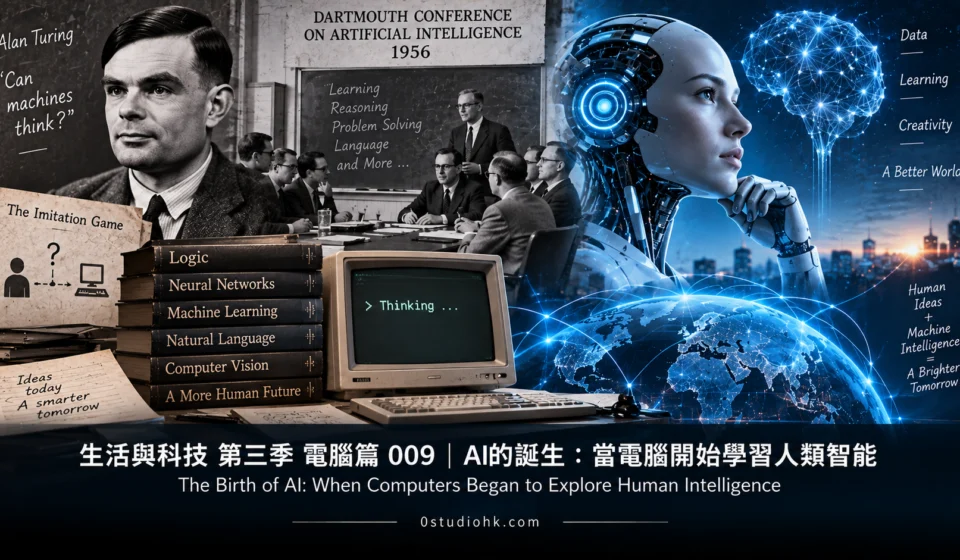
電腦最初被設計出來,是為了計算得更快、更準確;但人類很快開始提出另一個更大膽的問題:如果電腦不只是計算數字,而是可以學習、推理、解決問題,甚至模仿人的思考,會發生什麼事?這個問題,最終開啟了人工智能的時代。
Early computers were built primarily to calculate numbers faster and more accurately. Yet researchers soon began asking a much more ambitious question: could a computer learn, reason, solve problems and perhaps imitate aspects of human intelligence? That question eventually gave rise to artificial intelligence and opened a completely new chapter in computing history.
中文
人工智能的誕生,其實比今天我們所說的 AI 熱潮早了數十年。當電子電腦開始出現之後,科學家已經不再只把電腦看成一部計算機,而開始思考一個更深層的問題:機器是否可以表現出某些原本被認為只有人類才具備的智能?第二次世界大戰之後,電子計算技術迅速發展,電腦開始能夠處理越來越複雜的數學與邏輯問題。1943 年,神經科學家 Warren McCulloch 與數學家 Walter Pitts 發表關於神經活動邏輯模型的重要研究,提出可以用數學方式描述類似神經元的運算,後來成為人工神經網絡思想的重要早期基礎。到了 1950 年,英國數學家 Alan Turing 發表著名論文《Computing Machinery and Intelligence》,直接提出「機器能思考嗎?」這個問題。他沒有單純爭論「思考」應該如何定義,而是提出著名的「模仿遊戲」,後來一般稱為 Turing Test,用來思考人類是否能夠透過交流分辨對方究竟是人還是機器。 這個想法非常重要,因為它把「機器是否真的有思想」這個哲學問題,轉化成一個可以進一步研究的計算問題。電腦到底能不能表現出類似智能的行為?如果可以,人類應該怎樣設計這種機器?到了 1950 年代初期,研究開始更加具體。科學家嘗試讓電腦處理邏輯、棋類、問題解決以及模式辨識等工作。1951 年,Marvin Minsky 與 Dean Edmunds 建造 SNARC,這是一個早期人工神經網絡實驗系統,嘗試模擬類似動物學習的行為。1952 年,Allen Newell 與 Herbert A. Simon 等人開始發展 Logic Theorist 等程式,嘗試利用電腦模擬人類解決問題的過程。這些研究雖然距離今天的 AI 非常遙遠,但它們開始建立一個重要概念:電腦未必只能按照固定公式進行計算,它也可以被設計成處理某些需要「推理」或「判斷」的問題。 真正的歷史轉折出現在 1955 年。當時 John McCarthy、Marvin Minsky、Nathaniel Rochester 和 Claude Shannon 共同提出一份名為《A Proposal for the Dartmouth Summer Research Project on Artificial Intelligence》的研究計劃,而「Artificial Intelligence」這個名稱正是在這份提案中正式出現。 1956 年夏天,研究人員在美國 Dartmouth College 舉行 Dartmouth Summer Research Project on Artificial Intelligence。這次聚會通常被視為人工智能作為一個正式研究領域的誕生起點。當年的研究人員相信,人類的學習、推理以及其他智能活動,或許可以被精確描述,然後由機器模擬出來。 這是一個非常大膽的想法。當時的電腦體積龐大、記憶體有限,運算能力與今天相比幾乎無法想像地弱,但研究人員已經開始想像一個未來:機器可以理解語言,可以解決問題,可以玩遊戲,可以學習規則,甚至可能模擬某些人類思考方式。1956 年之後,AI 研究逐漸在大學和研究實驗室發展,研究方向包括邏輯推理、棋類遊戲、自然語言、機器學習以及神經網絡等。早期 AI 很多時候依靠人類預先寫好的規則,研究人員會把知識和邏輯轉換成電腦可以執行的形式,讓電腦根據這些規則尋找答案。這種方法在某些問題上十分有效,但也很快遇到限制。現實世界的知識太多,語言太複雜,而人類自己也很難把所有判斷規則完整寫下來。於是另一條道路逐漸發展起來:讓電腦不只是依靠人類逐條告訴它答案,而是從資料和經驗中尋找規律。1957 年,Frank Rosenblatt 發展 Perceptron,這是一種早期人工神經網絡模型,能夠根據輸入調整權重並進行模式辨識,被視為後來神經網絡與機器學習發展的重要早期工作。 然而,AI 的發展並不是一路直線上升。早期研究曾經充滿樂觀期待,但實際運算能力、資料量和演算法都受到限制,部分研究方向後來遇到瓶頸,人工智能也曾經歷研究資金減少及發展放緩的時期。直到電腦硬件快速進步、互聯網帶來龐大數據、圖形處理器提供強大平行運算能力,以及新的機器學習和深度學習方法逐漸成熟,AI 才再次快速發展。今天的生成式 AI 可以生成文字、圖片、聲音、影片與程式碼,看起來與 1950 年代的夢想相距極遠,但它的核心問題其實沒有完全改變:人類仍然在嘗試理解智能,也仍然在探索機器可以做到什麼。2026 年正好是 Dartmouth 1956 年 AI 研討會七十周年,Dartmouth 亦正在舉行相關紀念活動,回顧這個研究領域從「機器能否模擬智能」一路發展到今天生成文字、圖像、程式碼及預測的人工智能系統。 因此,AI 的誕生並不是某一部電腦突然「變聰明」的故事,而是一群科學家逐步改變對電腦想像的結果。電腦原本只是計算工具,後來成為可以執行程式的機器,再進一步成為研究學習、推理、語言和智能的實驗平台。從 Turing 在 1950 年提出的問題,到 Dartmouth 在 1956 年正式建立 AI 研究領域,再到今天的生成式人工智能,這條歷史線其實一直圍繞著同一個問題:如果人類可以用電腦模擬某些智能,那麼電腦究竟可以走多遠?
English Version
The birth of artificial intelligence did not happen suddenly in the modern era. Long before today’s generative AI systems could write articles, create images or generate computer code, scientists were already asking whether machines could reproduce some aspects of human intelligence. After the Second World War, electronic computers became increasingly powerful, and researchers began to see them as more than calculating machines. They could potentially become experimental platforms for studying reasoning, learning and problem-solving. One of the important early intellectual foundations came in 1943, when Warren McCulloch and Walter Pitts published influential work describing how neural activity could be represented through mathematical logic. Their ideas later became part of the intellectual history behind artificial neural networks. By 1950, British mathematician Alan Turing had taken the discussion much further. In his paper “Computing Machinery and Intelligence”, he asked the famous question: “Can machines think?” Rather than spending the entire discussion trying to define what thinking actually meant, Turing proposed the “imitation game”, which later became widely associated with the Turing Test. The basic idea was to consider whether a human could distinguish a machine from a person through communication. This was an important change in perspective. Instead of treating machine intelligence purely as a philosophical question, Turing turned it into something that could be discussed in terms of observable behaviour and computation. If a machine could produce intelligent-looking behaviour, how should scientists understand and measure it? During the early 1950s, researchers began building experimental programmes that attempted to reproduce specific forms of human problem-solving. Marvin Minsky and Dean Edmunds developed SNARC in 1951, an early neural-network machine designed to explore learning-like behaviour. In 1952, researchers including Allen Newell and Herbert A. Simon developed programmes such as Logic Theorist, which attempted to reproduce aspects of human reasoning through computation. These systems were extremely limited compared with modern AI, but they introduced an important new possibility: computers did not necessarily have to be limited to numerical calculation. They could also be designed to work with logic, rules, patterns and problems that appeared to require reasoning. The decisive milestone came in 1955, when John McCarthy, Marvin Minsky, Nathaniel Rochester and Claude Shannon proposed a research project called “A Proposal for the Dartmouth Summer Research Project on Artificial Intelligence”. It was in this proposal that the term “artificial intelligence” was introduced. The following summer, in 1956, a group of researchers gathered at Dartmouth College for the Dartmouth Summer Research Project on Artificial Intelligence. The workshop is widely regarded as the birth of artificial intelligence as a formal field of research. The researchers proposed that learning and other aspects of intelligence might be described precisely enough for a machine to simulate them. The ambition was remarkable considering the technology available at the time. Computers were enormous, expensive and extremely limited by modern standards. Memory was tiny, processing power was scarce, and programming was difficult. Yet researchers were already imagining machines that could reason, solve problems, understand language and perhaps learn. Following the Dartmouth workshop, artificial intelligence research expanded across universities and laboratories. Researchers explored symbolic reasoning, games such as chess, natural language, problem-solving and neural networks. Much of early AI relied on rules written by humans. Researchers attempted to represent knowledge and logic in a form that a computer could process. For certain well-defined problems, this approach could be surprisingly effective. But it also exposed a major limitation. The real world contains enormous amounts of knowledge and uncertainty, while human language is full of ambiguity and context. It is extremely difficult for people to write down every rule that another machine would need in order to behave intelligently. This helped encourage another approach: instead of telling a computer every rule explicitly, perhaps the computer could learn patterns from data and experience. In 1957, psychologist and computer scientist Frank Rosenblatt developed the Perceptron, an early artificial neural network capable of learning weights for pattern recognition. Although the Perceptron was limited and could not solve every kind of problem, it became an important milestone in the longer history of neural networks and machine learning. The development of AI was not a straight path towards today’s technology. Early researchers were often extremely optimistic about how quickly machines might achieve human-like abilities, but practical limitations in computing power, data and algorithms repeatedly slowed progress. AI research went through periods of reduced funding and enthusiasm before later technological advances changed the situation. Faster processors, enormous digital datasets, specialised hardware such as GPUs, improved algorithms and advances in machine learning and deep learning eventually transformed what computers could do. The AI systems of today may appear radically different from the machines imagined in the 1950s, but the underlying question remains surprisingly similar. Can aspects of human intelligence be represented, learned or simulated by machines? Modern generative AI can produce text, images, audio, video and computer code, capabilities that would have seemed extraordinary to the researchers at Dartmouth. In 2026, Dartmouth is marking the seventieth anniversary of the 1956 workshop, looking back at how the field developed from its original question about whether machines could simulate intelligence into today’s systems capable of generating content and making complex predictions. The birth of AI, therefore, was not the moment when one particular computer suddenly became intelligent. It was the result of a gradual change in how scientists imagined computers. First, computers were built primarily as calculating machines. Then they became programmable systems capable of handling increasingly complex tasks. Eventually, researchers began treating them as experimental platforms for exploring learning, reasoning, language and intelligence itself. From Turing’s question in 1950, through the Dartmouth workshop of 1956, to today’s generative AI, the history of artificial intelligence can be understood as one long attempt to answer a remarkably simple but profound question: if humans can use computers to simulate aspects of intelligence, how far can machines ultimately go?
總結 | 中文 |English Version
AI 的誕生,是電腦歷史一次重要的思想轉變。從 Turing 的「機器能思考嗎?」到 1956 年 Dartmouth 正式提出人工智能研究,電腦開始由計算工具變成探索人類智能的實驗平台,而這條道路最終走向今天的生成式 AI。
The birth of AI marked a major change in the history of computing. From Turing’s question about whether machines could think to the Dartmouth workshop of 1956, computers became more than calculating machines. They became experimental platforms for exploring learning, reasoning and intelligence, eventually leading to today’s generative AI.