
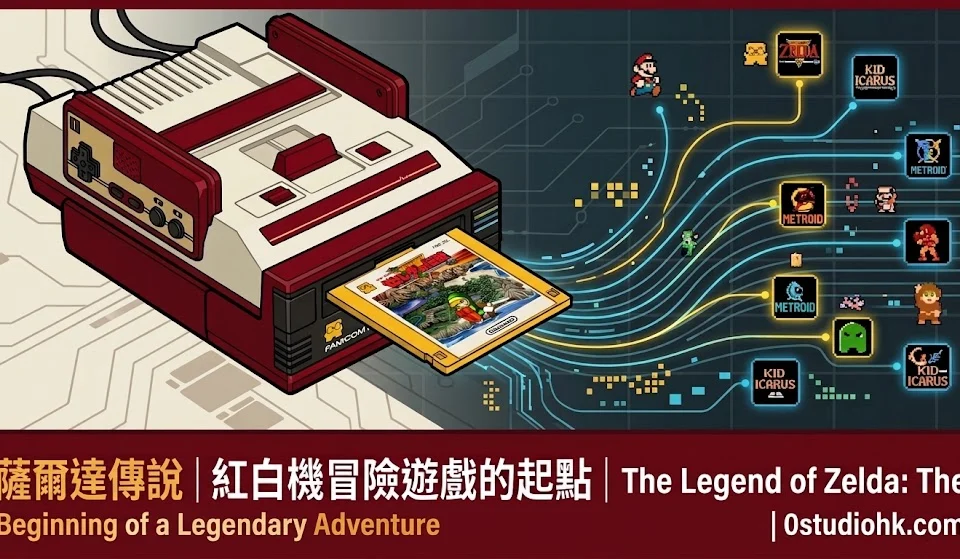
薩爾達傳說|紅白機冒險遊戲的起點|The Legend of Zelda: The Beginning of a Legendary Adventure

1986年,《薩爾達傳說》隨FC磁碟機登場,把探索、戰鬥、解謎與尋找秘密結合在一起,建立任天堂另一個經典系列。
In 1986, The Legend of Zelda introduced a new kind of console adventure, combining exploration, combat, puzzles and hidden discoveries into one mysterious world.
中文
1986年2月21日,任天堂推出FC磁碟機,而與這套新硬件同步登場的其中一款重要作品,就是後來成為世界知名系列開端的《薩爾達傳說》。在今天的玩家眼中,《薩爾達傳說》已經是一個擁有數十年歷史的大型遊戲系列,但在最初的1980年代,它其實是一個相當大膽的遊戲實驗。當時家用遊戲機上的作品大多圍繞動作、射擊、平台跳躍或簡單的迷宮玩法,而任天堂希望製作一款更加強調探索與發現的冒險遊戲。宮本茂與手塚卓志參與設計及監督開發,遊戲最終建立了一個名為海拉爾的幻想世界,玩家控制少年林克,在廣闊的地面世界與地下迷宮之間探索,尋找武器、道具及隱藏道路,同時對抗各種敵人。故事的核心,是大魔王加儂入侵海拉爾,奪走力量三角力量,而塞爾達公主則將智慧三角力量分成八個碎片並藏起來,之後被加儂抓走。林克的任務,就是尋找八塊智慧三角力量碎片,逐步取得足以挑戰加儂的力量,最後救出塞爾達公主。相比當時很多遊戲直接告訴玩家應該往哪裡走,《薩爾達傳說》最特別的地方,是它鼓勵玩家自己尋找答案。遊戲採用俯視視角,玩家可以在海拉爾世界中自由移動,遇到敵人便戰鬥,找到洞穴便探索,發現可疑的牆壁、樹木或地形時,又可能找到隱藏道路或秘密。這種「不知道前面有甚麼」的感覺,成為整個系列非常重要的特色。任天堂官方後來回顧這款作品時,也提到開發概念與「劍與魔法的世界」以及尋寶式冒險有關。遊戲的開發其實早於《超級瑪利歐兄弟》,兩款作品曾經並行製作,只是因為《薩爾達傳說》是FC磁碟機專用作品,團隊決定先完成《超級瑪利歐兄弟》,之後才正式推出《薩爾達傳說》。 FC磁碟機對這款遊戲也有特殊意義。當時磁碟媒介提供比一般ROM卡帶更大的記憶空間,而且可以儲存遊戲進度,讓玩家不需要每次重新開始。任天堂後來指出,FC磁碟機的磁碟容量及存檔功能,正是這種冒險遊戲能夠發展的重要條件之一。 《薩爾達傳說》的另一個特色,是它沒有把所有答案直接放在玩家面前。玩家需要記住地圖位置、尋找道具用途、觀察敵人模式,甚至與遊戲世界中的人物互動,才有機會逐步解開謎題。當年遊戲還附有說明書及攻略性質的內容,任天堂希望透過這些資料幫助第一次接觸冒險遊戲的玩家理解世界與玩法。宮本茂後來回憶,這些說明資料不只是操作指南,也希望建立遊戲的世界觀與冒險感。 《薩爾達傳說》在日本推出一年多後,於1987年以NES卡帶形式進入北美及歐洲市場。海外版本除了改用卡帶,也加入電池備份功能,成為早期家用遊戲機中可以保存遊戲進度的重要作品之一。 日本磁碟版與海外卡帶版亦存在一些細節差異,例如聲音、字體以及部分迷宮內的敵人配置並不完全相同。任天堂後來特別整理過這些版本差異,讓玩家可以從聲音與遊戲細節感受兩個版本的不同。 遊戲完成主線後,還可以進入另一套重新安排的挑戰內容,也就是後來玩家熟悉的「Second Quest」。它重新安排迷宮與部分道具位置,並提高部分敵人的挑戰程度,使已經熟悉第一輪遊戲的玩家再次探索同一個世界。 從今天回頭看,《薩爾達傳說》最重要的地方並不只是它推出了另一個任天堂角色,而是它改變了玩家與遊戲世界之間的關係。玩家不再只是按照關卡一路向前,而是需要自己探索、記憶、判斷與發現。海拉爾這個世界最初只有有限的畫面與簡單的像素圖像,但它卻讓玩家產生了一種「前面一定還有東西」的感覺。這種探索精神,後來成為整個《薩爾達傳說》系列的重要基礎。1986年的第一作,從一套FC磁碟機遊戲開始,最後發展成任天堂歷史上最具代表性的遊戲系列之一。它證明了家用遊戲機不一定只能提供短暫的動作挑戰,也可以讓玩家進入一個需要自己探索與理解的世界。從一把劍開始,到尋找三角力量,再到走進一個又一個秘密迷宮,《薩爾達傳說》真正開啟的,其實是一種新的遊戲思考方式。
English Version
When The Legend of Zelda arrived in Japan on February 21, 1986, it represented a different direction for home console games. Released for the Famicom Disk System, the first Zelda was built around exploration rather than simply moving from one stage to the next. Players entered the fantasy land of Hyrule as Link, a young hero searching for the eight fragments of the Triforce of Wisdom while preparing to confront the demon king Ganon and rescue Princess Zelda. The story provided the framework, but the real attraction was the world itself. Hyrule was designed as a place that encouraged curiosity. A player might discover a cave, encounter a suspicious section of terrain, find a hidden passage or obtain an item whose purpose was not immediately obvious. Instead of presenting every solution directly, the game encouraged experimentation and observation. This approach gave the adventure a sense of mystery that was unusual for many console games of its era. The game was created by Nintendo’s development team under the direction of Shigeru Miyamoto and Takashi Tezuka. Nintendo’s later interviews reveal that Zelda was actually being developed alongside Super Mario Bros., with Zelda’s development beginning earlier. Because Zelda was intended for the Famicom Disk System, however, the team completed Super Mario Bros. first before releasing Zelda with the new disk hardware. Miyamoto later described the concept in terms of a world of swords and magic combined with an adventure based around treasure hunting and discovery. The Disk System itself played an important role in making this type of game possible. Compared with the ROM cartridges used by the Famicom at the time, the disk format offered additional memory capacity and, crucially, the ability to save game data. For an adventure game built around exploration, multiple dungeons and a growing collection of equipment, being able to preserve progress made a significant difference to the experience. Nintendo later explained that the Disk System’s storage and save capabilities were closely connected to the design of the original Zelda. The player’s journey through Hyrule was deliberately open-ended. Link could acquire a sword, search for equipment, enter underground dungeons, defeat enemies and gradually uncover the larger structure of the world. Some discoveries required the player to remember locations or understand how an item could be used. Others depended on noticing something unusual in the environment. The game therefore rewarded attention as much as reflexes. Nintendo also provided a substantial instruction booklet containing information about the story, gameplay and hints. Miyamoto later explained that the booklet was intended not only to teach players how to play, but also to strengthen the atmosphere of the adventure and fantasy world. The original Japanese version used the subtitle “The Hyrule Fantasy,” reflecting the developers’ intention to create a larger fantasy setting rather than simply another isolated action game. The world of Hyrule became the foundation for an entire franchise, while characters such as Link, Zelda and Ganon gradually became some of Nintendo’s most recognizable figures. More than a year after its Japanese debut, The Legend of Zelda reached North America and Europe on the Nintendo Entertainment System. Because the Famicom Disk System was never released outside Japan, the international version was distributed on cartridge. The North American version was notable for using battery-backed memory to save game progress, helping make persistent save data a familiar feature of console games. The Japanese disk version and international cartridge version were not completely identical. Nintendo has documented differences in sound, fonts and some enemy placements. The Disk System version could also take advantage of an additional audio channel, giving the Japanese release a somewhat different sound character. Another important feature was the Second Quest. After completing the main adventure, players could enter a rearranged version of the game featuring different dungeon layouts and item locations, along with more demanding encounters. This effectively gave experienced players another reason to explore Hyrule after finishing the first journey. What made the original Zelda particularly influential was the relationship it created between the player and the game world. Instead of treating the screen as a fixed obstacle course, Nintendo created a space that invited players to investigate. The player was expected to remember discoveries, experiment with equipment, search for hidden routes and gradually construct an understanding of Hyrule. The graphics were limited by the technology of the period, yet the design created an unusually strong sense of scale and mystery. Every unexplored corner suggested another secret. Every new item raised another question. Every dungeon represented another challenge. That basic philosophy became one of the defining principles of the Zelda series. The first game therefore occupies an important place in the history of console adventure games. It showed that a home console could provide more than short bursts of action: it could create a world in which players explored at their own pace and solved problems through curiosity and persistence. What began in 1986 as a Famicom Disk System launch title eventually became one of Nintendo’s most enduring franchises. The original adventure was technically modest compared with later Zelda games, but its central idea remained remarkably powerful: give players a world, give them the tools to explore it, and allow the discovery itself to become part of the game.
總結
《薩爾達傳說》第一作把探索、戰鬥、解謎與秘密融合在一起,讓玩家真正走進一個可以自行發現的遊戲世界,也奠定了系列數十年的冒險精神。
The original Zelda transformed console adventure by making discovery part of the experience. Its small pixel world became the foundation for a franchise built on exploration, mystery and the freedom to find answers.