
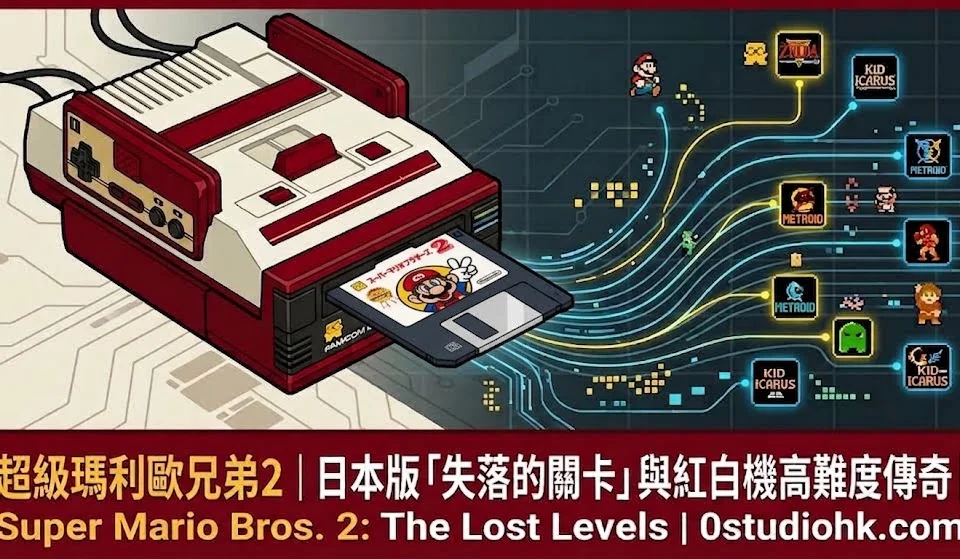
超級瑪利歐兄弟2|日本版「失落的關卡」與紅白機高難度傳奇|Super Mario Bros. 2: The Lost Levels

1986年,任天堂推出《超級瑪利歐兄弟2》,這款FC磁碟機遊戲延續前作玩法,卻以更高難度挑戰熟悉瑪利歐的玩家,後來成為「失落的關卡」。
In 1986, Nintendo released a very different sequel to Super Mario Bros. Designed for experienced players, it pushed the original formula to a much harder level and was later known in the West as The Lost Levels.
中文
1985年,《超級瑪利歐兄弟》推出後迅速成為任天堂紅白機最具代表性的作品之一,而成功亦令任天堂很快開始思考下一集應該怎樣製作。對宮本茂而言,續作並不只是把原來的關卡重新排列,而是希望真正考驗已經熟悉第一集玩法的玩家。當時他認為不少FC遊戲的難度仍然偏低,加上開發過程中發現初代遊戲的一些程式漏洞與特殊現象,於是產生了製作一款「給高手玩的瑪利歐」的想法。1986年6月3日,《超級瑪利歐兄弟2》在日本正式推出,平台正是任天堂當時正在推廣的FC磁碟機。遊戲沿用了第一集的基本背景與操作方式,玩家仍然要控制瑪利歐或路易吉穿越蘑菇王國,避開敵人與陷阱,擊敗庫巴的手下,最後救出被擄走的桃花公主。表面上,它看起來仍然是一款熟悉的《超級瑪利歐兄弟》,但真正開始遊玩後,玩家很快便會發現這一次的設計完全不是單純的「第二集」。遊戲沿用前作的引擎與視覺風格,但關卡設計明顯更加嚴格,要求玩家對跳躍距離、敵人的位置、移動速度以及地形變化有更精準的掌握。這種設計並不是偶然,而是開發團隊有意把遊戲定位在熟悉初代的玩家之上。宮本茂當時仍然參與FC磁碟機另一款重要作品《薩爾達傳說》的開發,因此續作首次由手塚卓志主導,宮本茂則在有空時參與關卡設計與修改。這也讓《超級瑪利歐兄弟2》成為一個有趣的系列轉折點:第一集負責讓大量玩家認識瑪利歐,而第二集則開始測試玩家究竟可以走到多遠。遊戲在日本推出後,任天堂原本曾經計劃將它帶到北美市場。然而,任天堂北美方面試玩後認為遊戲難度過高,不適合當時剛剛逐步恢復的北美家用遊戲市場。於是,日本版《超級瑪利歐兄弟2》沒有按照原計劃直接在北美推出。任天堂最後採用了另一個非常特別的解決方法:以原本由任天堂與富士電視台合作開發的FC磁碟機遊戲《夢工廠悸動恐慌》作為基礎,重新設計成一款瑪利歐作品。原作的四名角色被改成瑪利歐、路易吉、碧姬公主與奇諾比奧,部分道具與內容亦改成瑪利歐系列元素,經過調整後成為北美版《Super Mario Bros. 2》,也就是後來日本推出的《Super Mario USA》。因此,這裡出現了一個非常容易令人混淆的歷史:日本玩家在1986年玩到的《超級瑪利歐兄弟2》,與北美玩家在1988年接觸的《Super Mario Bros. 2》,其實不是同一款遊戲。多年後,任天堂才重新把日本版帶向海外。1993年,《超級瑪利歐兄弟2》收錄於超級任天堂的《超級瑪利歐收藏輯》,並以《Super Mario Bros.: The Lost Levels》的名稱出現,讓海外玩家第一次較正式地接觸這款原本只在日本推出的續作。這個「Lost Levels」名稱非常貼切,因為它就像是藏在早期瑪利歐歷史中的另一條路線:不是另一套角色、另一個世界,而是把第一集的遊戲規則推向更加嚴格的方向。之後,遊戲又陸續移植到Game Boy Advance、Wii Virtual Console、Nintendo 3DS、Wii U及Nintendo Switch Online等平台,2020年更收錄於35周年限定版Game & Watch: Super Mario Bros.。因此,一款原本只為FC磁碟機設計、而且曾經因難度問題沒有直接進入北美市場的遊戲,最終反而在多年後成為瑪利歐系列歷史中相當特殊的一章。它沒有像第一集一樣單純代表「瑪利歐第一次成功」,而是代表任天堂在系列成名之後開始思考另一個問題:當玩家已經學懂遊戲規則之後,還可以把挑戰推到甚麼程度?這也令《超級瑪利歐兄弟2》成為一款很有時代特色的作品。它不是重新發明瑪利歐,而是在原有基礎上把難度、技巧與關卡設計推向另一個極端。對很多玩家而言,它後來最令人熟悉的名字並不是「第二集」,而是《The Lost Levels》——那些曾經沒有正式走向海外市場的關卡,最終成為瑪利歐歷史中一段被重新發現的遊戲記憶。
English Version
The story of Super Mario Bros. 2 is more complicated than its title suggests. Released in Japan on June 3, 1986 for the Famicom Disk System, the game was designed as a direct continuation of the original Super Mario Bros. Rather than radically changing the formula, Nintendo took the familiar platforming system and pushed its demands much further. Mario and Luigi once again travel through the Mushroom Kingdom, facing enemies and obstacles on the way to rescuing Princess Peach from Bowser. The visual presentation remained close to the original, and the basic gameplay engine was also retained. What changed was the philosophy behind the level design. The first Super Mario Bros. had introduced a huge audience to side-scrolling platform games, teaching players how to run, jump, avoid enemies and understand the rhythm of a Mario level. The sequel was aimed at people who had already mastered those fundamentals. Shigeru Miyamoto wanted to create a game that could challenge experienced players rather than simply offer another beginner-friendly adventure. The development situation was also different from the first game. Miyamoto was heavily involved in the development of The Legend of Zelda for the Famicom Disk System, so Takashi Tezuka took the leading role in directing the sequel. Miyamoto nevertheless continued to contribute to level design and adjustments when time allowed. The result was a game that looked familiar but behaved very differently. Players were expected to understand movement with much greater precision, learn the behavior of enemies and carefully judge jumps and hazards. The sequel therefore became closely associated with extreme difficulty. Nintendo initially planned to release the Japanese game in North America, but Nintendo of America reportedly considered the game too difficult for the recovering American video game market. Instead of simply localizing the Japanese sequel, Nintendo chose a completely different solution. A Japanese Famicom Disk System title called Yume Kōjō: Doki Doki Panic, developed through a collaboration involving Nintendo and Fuji Television, was adapted into a new Mario game. Its four original characters were replaced by Mario, Luigi, Princess Peach and Toad, while objects and visual elements were redesigned around the Mario universe. The result became the North American Super Mario Bros. 2 and was later released in Japan as Super Mario USA. This created one of the most unusual naming situations in Nintendo history. The Japanese Super Mario Bros. 2 and the Western Super Mario Bros. 2 were not actually the same game. For years, Western players therefore had a completely different experience of what they believed was the second Mario platform game. The original Japanese sequel eventually reached international audiences in 1993 through Super Mario All-Stars on the Super Nintendo, where it was given the subtitle The Lost Levels. The new name helped distinguish it from the Western Super Mario Bros. 2 and also captured the game’s unusual history. It was effectively a missing branch of the Mario series that had remained outside the Western market for several years. After its appearance in Super Mario All-Stars, The Lost Levels continued to return on later Nintendo platforms. It was released for the Game Boy Advance in 2004 as part of the Famicom Mini series, followed by appearances through Virtual Console on Wii, Nintendo 3DS and Wii U. In 2019, it became available through Nintendo Switch Online, and the game was also included in the 2020 limited-edition Game & Watch: Super Mario Bros. These later releases gradually transformed the game from an obscure Japanese sequel into a recognized part of Mario history. Its importance is not simply that it was the second Mario platform game. It demonstrates how Nintendo experimented with difficulty and player expectations immediately after the enormous success of the original. Instead of making every aspect more accessible, the developers asked what would happen if the same basic mechanics were presented to players who already understood them extremely well. That approach produced a game remembered for demanding precision and persistence. The history of Super Mario Bros. 2 also demonstrates how regional game markets could shape the identity of a major franchise. Japanese players received one sequel, while North American players received another game carrying the same title. Decades later, both versions became part of the broader Mario story. The Japanese game eventually found its place as The Lost Levels, while the Western game developed its own identity and became an important Mario title in its own right. Looking back, the original Super Mario Bros. 2 is therefore more than a difficult sequel. It is a snapshot of Nintendo during an important period of experimentation, when the company was exploring new hardware through the Famicom Disk System and testing how far a successful game formula could be pushed. What began as a demanding sequel for experienced players eventually became one of the most unusual chapters in the history of the Mario franchise.
總結
《超級瑪利歐兄弟2》最特別之處,不只是難度高,而是它留下了一段獨特的遊戲歷史:日本版與海外版走上不同道路,最終「失落的關卡」才重新被世界玩家認識。
Super Mario Bros. 2 remains unusual because its history split into two different versions. The Japanese sequel became The Lost Levels, turning an initially local experiment into a distinctive part of Mario’s international legacy.