
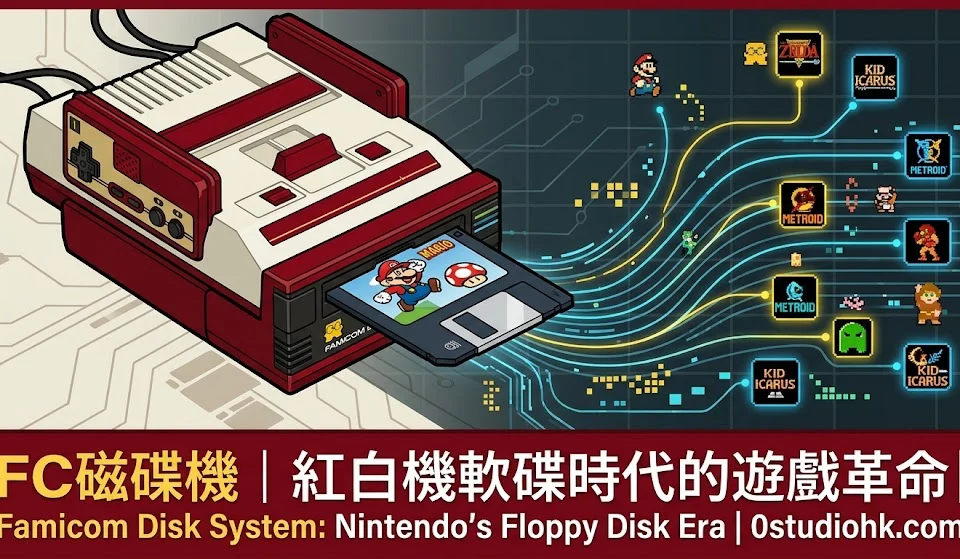
FC磁碟機|紅白機軟碟時代的遊戲革命|Famicom Disk System: Nintendo’s Floppy Disk Era

1986年,任天堂為紅白機帶來FC磁碟機,以可重寫軟碟取代部分卡帶功能,讓遊戲容量、價格與遊玩方式出現新的可能。
In 1986, Nintendo introduced the Famicom Disk System, bringing rewritable floppy disks to the Famicom and opening a new chapter in game storage, distribution, and interactive entertainment.
中文
1980年代的電子遊戲世界,卡帶幾乎就是家用遊戲機的主要媒介。它讀取速度快,也方便玩家直接插入主機遊玩,但當時的卡帶容量有限,而且製造成本較高,對遊戲開發商和消費者而言都形成一定負擔。任天堂在紅白機取得成功後,開始尋找另一種更具彈性的遊戲媒介。當時軟碟已經廣泛應用於電腦領域,而軟碟具備較大的儲存空間、較低的製造成本以及可以重新寫入的特性,令任天堂看到了新的可能。經過研究後,任天堂以3英寸QD軟碟作為基礎,開發出專為紅白機使用的FC磁碟機。1986年2月21日,FC磁碟機正式在日本推出,售價15,000日圓。它並不是一部完全獨立的新主機,而是紅白機的外接設備,玩家需要把磁碟機與紅白機連接,才能遊玩專用軟碟遊戲。這種設計在當時相當新鮮,因為遊戲不再只是購買一盒固定內容的卡帶,而可以透過軟碟形式儲存及更新遊戲。FC磁碟機推出時,首批作品包括《棒球》、《高爾夫球》、《麻雀》、《足球》、《網球》,以及《超級瑪利歐兄弟》的移植版本,同時還有專門利用軟碟特性的《薩爾達傳說》。其中一項非常特別的安排,是任天堂在日本各地遊戲零售商設置專用的軟碟讀寫機。玩家只需支付一次500日圓的費用,就可以把新的遊戲寫入原有軟碟。相比當時一般卡帶超過2600日圓的售價,這種方式顯得相當吸引。換句話說,FC磁碟機不只是改變了遊戲的儲存媒介,也嘗試改變遊戲的銷售模式。部分讀寫機更加入傳輸功能,玩家可以把支援相關功能的軟碟帶到指定地點,將遊戲成績傳送給任天堂,甚至參與全日本玩家之間的競賽。這種概念放在今天看來,很像早期的數碼內容更新、排行榜以及線上服務雛形。FC磁碟機最初的發展相當成功,1986年單年便售出約200萬部。然而,它的優勢並沒有維持太久。到了1986年中期,容量更大的卡帶技術開始出現,部分遊戲已經能夠突破早期卡帶容量的限制。同時,卡帶加入電池備份後,也能提供即時存檔功能,使軟碟原本的一項重要優勢逐漸失去獨特性。另一方面,卡帶的製造成本亦逐步下降,FC磁碟機原本在價格方面的吸引力開始減弱。進入1990年代後,16位元遊戲機成為市場新焦點,超級任天堂與Mega Drive等新一代主機帶來更強的畫面、音效及遊戲表現,FC磁碟機自然逐漸退出主流市場。1990年主機硬件停產,最後一款官方授權遊戲於1992年推出,零售商的軟碟改寫服務其後停止,而任天堂官方軟碟改寫服務直到2003年才正式終止。2007年10月,FC磁碟機的維修服務亦告結束,這個曾經代表新媒介可能性的遊戲系統,正式完成它的歷史任務。FC磁碟機一生累計銷量約444萬部。從後來的遊戲產業發展來看,它並沒有成為取代卡帶的主流格式,但它留下的意義並不只在銷量。它曾經嘗試把遊戲變成可以重新寫入、重新取得甚至更新的數碼內容,也讓玩家第一次較直接地接觸到遊戲零售服務與內容傳輸的概念。從今天回頭看,FC磁碟機或許是一個沒有完全成功的產品,但它卻非常早地展示了一種遊戲未來可能走向的方向。
English Version
The Famicom Disk System was one of Nintendo’s most interesting experiments during the early development of home video games. When it appeared in Japan in 1986, cartridges were still the standard way of distributing games for home consoles. Cartridges offered fast loading and simple operation, but they were also relatively expensive to manufacture and had limited storage capacity. Nintendo was therefore looking for another solution that could provide more flexibility without abandoning the enormous installed base of the Famicom. Floppy disks offered an intriguing alternative. Compared with contemporary cartridges, disks could provide more storage at a lower manufacturing cost, and their rewritable nature created the possibility of distributing different games without requiring a completely new physical cartridge each time. Nintendo based its system on a customized three-inch Quick Disk format and developed the Famicom Disk System as an add-on for the original Famicom. Released in Japan on February 21, 1986, the system cost 15,000 yen and connected to the Famicom rather than replacing it. The launch lineup demonstrated both familiar and experimental directions. Existing games such as Baseball, Golf, Mahjong, Soccer, Tennis and Super Mario Bros. were represented, while The Legend of Zelda was designed to take advantage of the new disk-based format. What made the system particularly unusual was not simply the disk itself, but the business model built around it. Nintendo installed dedicated disk-writing machines at video game retailers throughout Japan. Instead of purchasing another expensive cartridge, players could pay a relatively small fee to have another game written onto their disk. At the time, this created a very different relationship between players, retailers and game software. Some machines also supported data transmission. Players could bring compatible disks to participating locations, have their scores processed and transmitted to Nintendo, and compete with other players across Japan. Looking at the concept from a modern perspective, the system contained early ideas that would later become familiar in digital gaming: downloadable content, reusable storage, score transmission, competitive rankings and software distribution through a network of dedicated services. The Famicom Disk System initially performed strongly, selling around two million units in Japan during 1986 alone. However, the advantages that had made the system attractive were gradually weakened by developments in cartridge technology. By the middle of the same year, larger-capacity cartridges were becoming possible, reducing one of the disk system’s biggest advantages. Battery-backed cartridges also introduced convenient save functionality, meaning that saving progress was no longer something unique to disk-based games. At the same time, cartridge manufacturing became less expensive, making the economic argument for disks increasingly difficult to maintain. The wider console market was also changing. By 1990, the industry had entered the 16-bit generation, with systems such as the Super Famicom and Mega Drive offering more advanced graphics, sound and increasingly sophisticated software. Against this new generation, the Famicom Disk System gradually became a product of an earlier era. Nintendo stopped producing the hardware in 1990. The final officially licensed game appeared in 1992, while retail disk-writing services disappeared afterward. Nintendo’s official disk rewriting service continued for several more years, finally ending in September 2003. Hardware repair support continued even longer, until October 2007. The complete lifespan of the system therefore stretched across several different stages of the Japanese video game industry. In total, approximately 4.44 million units were sold. By the standards of Nintendo’s most successful hardware platforms, that figure was modest, and the Disk System did not replace cartridges as the dominant format. Yet its historical importance lies in what Nintendo attempted rather than simply in its sales numbers. The Famicom Disk System treated games as something that could be rewritten, redistributed and updated instead of being permanently fixed inside a single cartridge. Its retailer-based writing stations also created a physical distribution network that anticipated some ideas later associated with digital distribution. The system was eventually overtaken by better cartridge technology and newer generations of consoles, but the experiment remains an important part of gaming history. It represents a moment when Nintendo was already exploring a question that would become increasingly important decades later: should a video game be treated as a physical product that is bought once, or as software that can continue to change after the player has taken it home?
總結
FC磁碟機未能取代卡帶,卻率先探索可重寫遊戲、低成本發行、成績傳輸等概念。它或許不是最成功的硬件,卻是任天堂遊戲媒介發展中相當重要的一次實驗。
The Famicom Disk System did not replace cartridges, but it explored rewritable games, alternative distribution and player data transmission years before these ideas became commonplace. Its legacy lies in experimentation as much as success.