
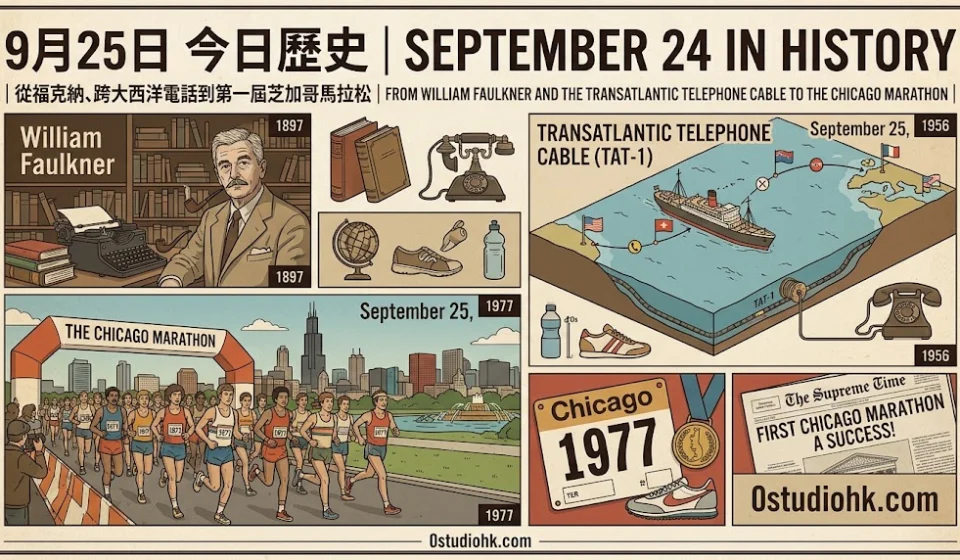
9月25日今日歷史|從福克納、跨大西洋電話到第一屆芝加哥馬拉松|September 25 in History|From William Faulkner and the Transatlantic Telephone Cable to the Chicago Marathon

9月25日連結文學、通信、醫療、運動與自然保護,從福克納的小說世界,到跨大西洋電話與芝加哥馬拉松。
September 25 connects literature, communication, medicine, sport and conservation, from William Faulkner’s fictional world to transatlantic calls and the Chicago Marathon.
中文版本
9月25日是一個可以從「人如何突破距離與限制」去理解的歷史日子。1897年9月25日,美國作家William Faulkner出生於密西西比州New Albany,後來成為20世紀美國文學的重要人物之一。美國國會圖書館資料指出,Faulkner年輕時主要在密西西比州Oxford成長,後來創造出虛構的Yoknapatawpha County,並以這個架空地區作為許多作品的背景。 他筆下的人物包括不同社會階層的人,小說經常處理家庭、社會、歷史記憶以及南方社會變化等問題。他最特別的地方,是沒有把小說局限在一個單純的故事,而是建立出一個具有地理、人物關係與歷史背景的虛構世界。讀者可以在不同作品中重新遇到相似的地方與人物,慢慢形成對這個世界的完整印象。這種寫法讓文學不只是講述一個事件,而可以像一幅長期累積的社會地圖。Faulkner的作品也經常以不同角度、不同時間順序描述事件,讓讀者從人物記憶與敘事片段中重新理解過去。這種寫作方式對後來的現代小說產生相當大的影響,也讓他成為研究美國南方文化與20世紀文學時的重要作家。9月25日另一項非常重要的歷史,是1956年第一條跨大西洋電話海底電纜TAT-1正式啟用。TAT-1連接加拿大Newfoundland的Clarenville、蘇格蘭Oban附近的Gallanach Bay,並在1956年9月25日正式投入服務。 在TAT-1之前,跨大西洋電話主要依靠無線電傳送,因此受到訊號品質、容量以及其他技術限制。TAT-1的出現,使跨越大西洋的電話通信第一次可以透過專門的海底電話電纜提供更穩定的語音服務。啟用當日,倫敦、渥太華與紐約進行了三地電話通話,象徵跨大西洋通信進入新的階段。 TAT-1最初只有36個電話頻道,但在正式服務的第一天已經處理了588個倫敦與美國之間的電話,以及119個倫敦與加拿大之間的電話,其後容量增加到48個頻道。 今天我們用手機或網絡與世界另一端的人通話,幾乎不會想到訊號其實需要經過非常複雜的全球基礎設施。海底電纜就是現代通信世界的重要基礎,而TAT-1可以看成這段歷史的重要里程碑。從19世紀的電報海底電纜,到20世紀的電話電纜,再到今天的光纖海底網絡,人類一直在嘗試把「距離」變得不再是一個通信障礙。9月25日也與醫療科技的一項重要發展有關。1974年,美國骨科醫生Frank Jobe為棒球投手Tommy John進行尺側副韌帶重建手術,這項手術後來普遍被稱為「Tommy John Surgery」。這種手術的概念,是利用人體其他部位的肌腱移植來取代受損的肘部韌帶,後來成為棒球及其他投擲運動中非常知名的重建手術。 這段醫療歷史有趣之處,在於它不是單純發明一種新藥,而是透過理解人體結構,尋找可以替代受損組織的方法。現代運動醫學很多突破也是從這種「修復」概念發展而來:醫生不只是治療疼痛,而是希望恢復患者原本的活動能力。這類手術後來受到廣泛討論,也讓運動員的長期健康與復康成為體育世界的重要議題。到了1977年9月25日,芝加哥舉行第一屆芝加哥馬拉松。當時約有4,200人參加,賽事最初稱為Mayor Daley Marathon,後來逐漸發展成今天世界知名的Chicago Marathon。 今天的芝加哥馬拉松已經成為全球大型城市馬拉松之一,但它的起點其實相當樸素。跑步並不需要複雜的設備,也不一定需要大型場館;一條城市道路、一群參加者以及一套清楚的比賽規則,就可以形成一項大型公共活動。馬拉松因此不只是一項體育比賽,也是一種城市文化。參賽者穿越城市街道,市民在路旁觀看和支持,城市本身變成比賽的一部分。這種城市馬拉松文化後來在世界不同地方發展,令跑步由個人運動逐漸變成一種大型社區活動。9月25日還是1890年Sequoia National Park成立的日子。美國國會於這一天建立Sequoia National Park,位於加州,以巨型紅杉樹聞名。 國家公園制度背後的理念,是把具有特殊自然價值的土地保存下來,讓它不只是屬於當代社會,也可以留給未來世代。巨型紅杉的壽命非常長,因此特別容易讓人感受到「時間」的尺度。人類的城市、道路和企業可以在幾十年內改變,但一棵古老的巨型紅杉可能已經存在了數百甚至更長時間。保護自然環境因此不只是保存景觀,也是在保存一種遠遠超越單一世代的時間記錄。1981年9月25日,Belize加入聯合國,成為聯合國會員國之一。 這件事代表一個國家正式加入國際組織體系,也反映20世紀後期國際社會版圖持續發生變化。Belize位於中美洲,英語是官方語言,社會文化同時受到加勒比海、中美洲及不同族群歷史影響。把這些事件放在一起看,9月25日其實有一條很清楚的主線:人類一直在突破不同形式的距離。Faulkner用文字建立一個可以讓讀者長期探索的虛構世界;TAT-1讓電話聲音跨越大西洋;醫療手術讓受傷的身體重新恢復活動能力;芝加哥馬拉松把人帶到城市街道上共同完成一項挑戰;國家公園則讓自然景觀跨越世代保存下來。它們看似沒有關係,卻都與「延伸」有關——把故事延伸到讀者,把聲音延伸到遠方,把身體能力延伸到復康,把個人運動延伸成城市文化,把自然景觀延伸到下一代。歷史不一定只發生在巨大事件之中。有時候,一部小說、一條海底電纜、一項醫療技術、一場馬拉松,甚至一片森林,都可以反映一個時代如何理解世界,以及人類如何利用創意、技術和制度去突破原本的限制。9月25日因此是一個很值得從日常角度重新看的日期:我們今天可以即時通話、閱讀世界各地的作品、接受複雜的醫療治療、參加大型城市運動活動,也可以走進受到保護的自然環境,這些看似理所當然的事情,其實都是很多代人的累積。歷史真正有意思的地方,也許正是當我們回頭看這些普通生活的一部分,才會發現它們背後都有一段很長的故事。
English Version
September 25 can be understood through a simple idea: people have repeatedly found ways to overcome distance and limitations. On September 25, 1897, American novelist William Faulkner was born in New Albany, Mississippi. He later became one of the major literary figures of the twentieth century. The Library of Congress notes that Faulkner spent much of his youth in Oxford, Mississippi, and created the fictional Yoknapatawpha County, a setting that became central to many of his works. Faulkner’s fictional world included characters from different social backgrounds and explored family relationships, social change, memory and the complicated history of the American South. One of the most distinctive aspects of his writing was his ability to turn a fictional place into something resembling a complete social landscape. Readers could encounter different characters and places across several works, gradually developing a deeper understanding of the fictional county and its history. His novels often experimented with narrative structure and perspective, asking readers to reconstruct events through memories, different viewpoints and changes in chronology. In this sense, Faulkner did more than tell individual stories. He created a literary environment that readers could return to and explore from different directions. His work became an important part of twentieth-century American literature and continues to be studied for both its literary techniques and its treatment of society and history. September 25 also marks a major milestone in the history of global communication. On September 25, 1956, TAT-1, the first transatlantic telephone cable system, officially entered service. The cable connected Clarenville in Newfoundland with Gallanach Bay near Oban in Scotland and created a new way of carrying telephone conversations across the Atlantic. Before TAT-1, transatlantic telephone communication depended largely on radio transmission. Radio made long-distance calls possible, but it also had limitations in signal quality and capacity. The new submarine cable provided a more reliable system for carrying voice calls. On the day of its inauguration, a three-way telephone conversation connected London, Ottawa and New York, symbolising a new stage in international communication. TAT-1 initially had 36 telephone channels, yet during its first 24 hours of public service it carried 588 calls between London and the United States and 119 calls between London and Canada. Its capacity was later increased to 48 channels. Today, people can make international calls through smartphones and internet services almost instantly, so it is easy to forget how difficult long-distance communication once was. Undersea cables remain fundamental to global communications, and TAT-1 represents an important stage in their history. From nineteenth-century submarine telegraph cables to twentieth-century telephone cables and today’s high-capacity fibre-optic networks, the basic objective has remained remarkably consistent: to make physical distance less of a barrier to communication. September 25 also has an important place in the history of sports medicine. In 1974, American orthopaedic surgeon Frank Jobe performed a reconstruction of the ulnar collateral ligament on baseball pitcher Tommy John. The procedure later became widely known as Tommy John surgery. It uses a tendon graft to replace a damaged ligament in the elbow and eventually became a well-known reconstructive procedure in baseball and other throwing sports. The significance of the procedure lies in its approach to repair. Instead of simply treating pain, doctors could reconstruct damaged tissue and attempt to restore function. Modern sports medicine has developed enormously since then, but the underlying idea remains important: understanding the structure of the body can allow doctors to find new ways to repair injuries and help people return to activity. The story also shows how medical developments can influence sporting culture. The health and recovery of athletes became increasingly connected with specialist medical knowledge, rehabilitation and long-term physical care. On September 25, 1977, another very different kind of physical challenge took place in Chicago: the first Chicago Marathon. About 4,200 runners took part in the inaugural race, which was originally known as the Mayor Daley Marathon. The event eventually developed into one of the world’s major city marathons. The early race was much smaller than the modern event, but the basic idea was already powerful. Running does not require a complicated stadium. A city can become the course, while roads, spectators, volunteers and participants create the event together. This is why major city marathons are more than sporting competitions. They can become part of urban culture. Participants move through familiar streets from a completely different perspective, while local residents become spectators and supporters. The city itself becomes part of the experience. Over time, this model of mass participation helped transform running from an individual activity into a major community event in many parts of the world. September 25 is also associated with conservation history. On September 25, 1890, Sequoia National Park was established in California by an act of Congress. The park is famous for its giant sequoia trees. The creation of a national park reflects an important idea: some landscapes have value beyond their immediate economic use and can be protected for future generations. Giant sequoias make this idea particularly powerful because of their enormous age and size. Human buildings, roads and businesses can change within decades, while individual trees may have existed for centuries. Conservation therefore involves more than protecting scenery. It also protects a connection with a much longer scale of time. A forest can become a living historical record, allowing future generations to experience something that existed long before them. Another September 25 milestone came in 1981, when Belize joined the United Nations. Membership of the United Nations marked Belize’s participation in the wider international community. Belize is located in Central America and has a cultural history influenced by Caribbean, Central American and different ethnic traditions. Its official language is English, another reflection of its particular historical development. When these events are considered together, September 25 reveals a surprisingly clear theme: extending human possibilities beyond their previous boundaries. Faulkner used words to create a fictional world that readers could explore across generations. TAT-1 allowed human voices to cross the Atlantic through a physical cable beneath the sea. Reconstructive surgery offered injured athletes a way to recover physical function. The Chicago Marathon turned individual running into a large-scale urban experience. Sequoia National Park preserved ancient trees beyond the lifespan of any single generation. These stories may seem unrelated, but each involves some form of extension. A story extends imagination into the mind of the reader. A communication cable extends the human voice across distance. Medical reconstruction extends the possibilities of physical recovery. A marathon extends individual effort into a shared community event. Conservation extends the life of a landscape into the future. This is one of the reasons history is often most interesting when viewed through ordinary life. International telephone calls, novels, medical treatment, public sporting events and protected forests can seem completely normal today, yet each depends on decisions, technologies and ideas developed by earlier generations. September 25 therefore provides a useful reminder that modern life is built from accumulated changes. The ability to communicate across oceans, read literature from another era, recover from serious injuries, participate in major sporting events or visit protected natural landscapes did not appear overnight. Each reflects people trying to solve problems, create new possibilities or preserve something they believed was worth keeping. History is not only about dramatic events. It is also about the gradual expansion of what ordinary people can do, experience and share.
總結
9月25日是一條「突破距離與限制」的歷史線:文學延伸想像,電纜延伸聲音,醫療延伸身體能力,馬拉松延伸城市文化,而自然保護則延伸記憶到下一代。
September 25 follows a theme of overcoming distance and limits: literature expands imagination, cables extend communication, medicine extends physical recovery, marathons turn effort into community culture, and conservation carries natural memory into the future.